Comprehensive Rehabilitation Protocol Following Quadriceps and Patellar Tendon Repair Surgery

Man performing bodyweight squats during knee rehab supervised by a physical therapist.

Introduction

Overview and Epidemiology

Quadriceps and patellar tendon ruptures are uncommon but debilitating injuries that disrupt the knee extensor mechanism, leading to significant functional impairment. Quadriceps tendon ruptures typically affect middle-aged men, often due to a traumatic eccentric contraction of the quadriceps muscle, while patellar tendon ruptures more commonly occur in younger individuals, often associated with chronic tendon degeneration or acute trauma. The incidence of patellar tendon rupture is estimated at approximately 0.48 to 1.09 per 100,000 person-years, with a higher occurrence in athletic populations and those with systemic comorbidities such as diabetes, rheumatoid arthritis, or corticosteroid use.

Treatment Options

Surgical repair remains the gold standard for complete ruptures to restore the extensor mechanism and enable knee extension. Repair techniques include primary end-to-end suture repair, transosseous tunnel fixation, and suture anchor repair, often augmented with cerclage wires, synthetic tapes, or autografts to enhance repair strength and allow early mobilization. Early surgical intervention is critical for optimal outcomes; chronic or delayed repairs may require more complex reconstructions with grafts.

Importance of Rehabilitation

Postoperative rehabilitation is crucial to restore knee range of motion (ROM), strength, and function while preventing complications such as joint stiffness and muscle atrophy. Early controlled mobilization and weight-bearing protocols have been shown to promote tendon healing, improve vascularity, and facilitate functional recovery without increasing complication rates.



Rehabilitation Protocol:

Stage 1: Immediate Postoperative Phase (0–2 weeks)

Goals:

  • Minimize swelling and pain.
  • Protect surgical repair.
  • Begin early restoration of joint mobility.
  • Prevent quadriceps muscle atrophy.

Precautions:

  • Use a hinged knee brace locked in extension or limited flexion (0°–30°) depending on surgeon recommendations.
  • Avoid active knee extension against resistance to protect repair.
  • Weight-bearing as tolerated with brace locked in extension unless otherwise contraindicated.

Interventions and Exercises (examples):

  • Quadriceps isometric contractions (quad sets).
  • Ankle pump exercises to promote circulation.
  • Passive knee range of motion (P-ROM) within safe limits (0°–30°, progressing as tolerated).
  • Patellar mobilization and scar tissue management.
  • Gait training with assistive devices and brace locked in extension.
  • Use of neuromuscular electrical stimulation (NMES) to reduce arthrogenic muscle inhibition.

Stage 2: Early Mobilization Phase (3–6 weeks)

Goals:

  • Gradually restore knee flexion ROM (target 90° by week 6).
  • Enhance quadriceps muscle recruitment.
  • Progress weight-bearing toward full as tolerated.
  • Initiate active range of motion (a-ROM) exercises.

Precautions:

  • Avoid excessive knee flexion beyond prescribed limits to prevent stress on repair.
  • Monitor pain levels; keep exercises within pain-free or minimal pain range.
  • Use brace as per protocol, gradually unlocking to allow increased motion.

Interventions and Exercises (examples):

  • Passive and active-assisted knee flexion exercises (heel slides, prone knee flexion).
  • Straight leg raises ensuring no extension lag.
  • Hip abduction/adduction in supine or side-lying positions.
  • Suspension therapy for knee flexion and extension.
  • Early closed kinetic chain (CKC) exercises such as mini-squats (0°–45° flexion).
  • Hydrotherapy pool walking to allow controlled weight-bearing and joint motion.
  • Continue NMES as necessary for quadriceps activation.

Stage 3: Strengthening and Gait Normalization (7–12 weeks)

Goals:

  • Achieve near full passive and active knee ROM (>120°).
  • Restore normal gait pattern.
  • Begin progressive strengthening of quadriceps and surrounding musculature.

Precautions:

  • Avoid exercises that cause pain or swelling increase.
  • Monitor for signs of tendon overload or inflammation.
  • Continue use of brace as needed; may start to discontinue based on stability and strength.

Interventions and Exercises (examples):

  • Progressive CKC exercises (leg press, step-ups, lunges within safe ROM).
  • Closed and open kinetic chain (OKC) strengthening with light resistance.
  • Balance and proprioception training (single-leg stance, perturbation).
  • Stationary cycling with low resistance and proper seat height adjustments.
  • Gait training without assistive devices as tolerated.
  • Begin low-impact cardiovascular activities (elliptical, swimming).

Stage 4: Advanced Strengthening and Functional Training (13–24 weeks)

Goals:

  • Restore full active ROM.
  • Increase muscular strength and endurance.
  • Improve neuromuscular control and proprioception.
  • Prepare for return to functional activities and sports-specific training.

Precautions:

  • Progress exercises cautiously to avoid overstressing repair.
  • Avoid high-impact activities until adequate strength and control are achieved.
  • Address any residual deficits in mobility or muscle recruitment.

Interventions and Exercises (examples):

  • Heavy slow resistance training (leg press, squats up to 90°).
  • Plyometric and eccentric training (step-downs, lateral lunges).
  • Sport-specific drills on varied surfaces (grass, sand).
  • Dynamic balance and agility training.
  • Core and hip strengthening to support knee mechanics.
  • Gradual progression of running on treadmill, starting with brisk walking and progressing to jogging.

Stage 5: Return to Sport and Full Activity (25+ weeks)

Goals:

  • Achieve pre-injury strength and function.
  • Complete sport-specific training and drills.
  • Minimize risk of re-injury through proper biomechanics and conditioning.

Precautions:

  • Continue monitoring for pain, swelling, or instability.
  • Avoid sudden increases in training intensity or volume.
  • Ensure full quadriceps strength symmetry and knee stability before unrestricted return.

Interventions and Exercises:

  • Full plyometric training including jumping, cutting, and landing mechanics.
  • Power and resistance trainings tailored to sport demands.
  • Multidirectional agility drills and acceleration/deceleration control.
  • Ongoing neuromuscular training and movement pattern correction.
  • Functional testing and return-to-play assessments.

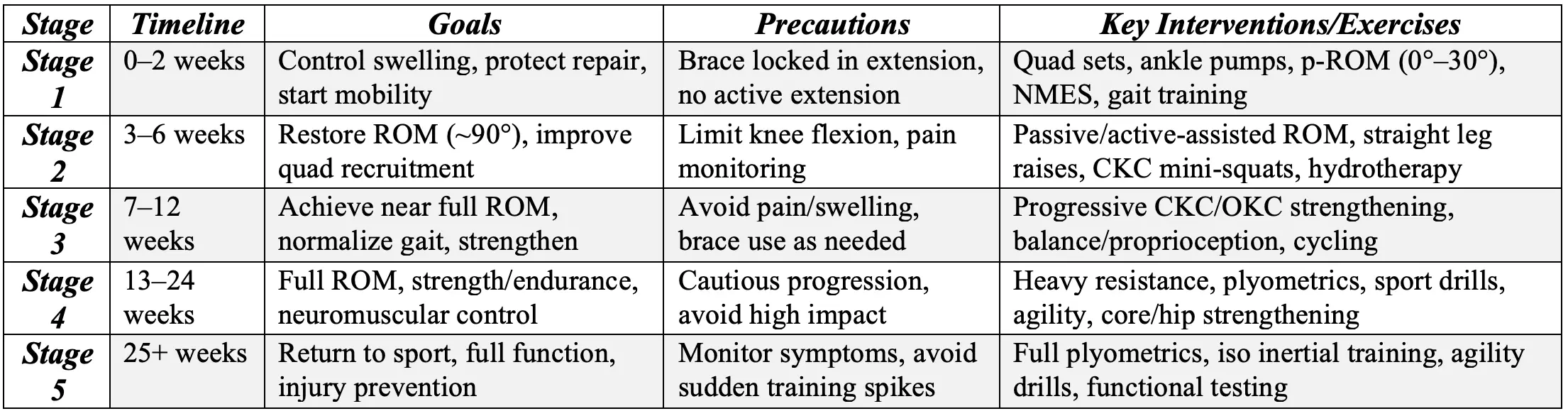
Summary Table of Rehabilitation Protocol

Summary table detailing the 5-stage rehabilitation protocol timeline after patellar tendon surgery. (100 characters)

Additional Important Points and New Findings

  • Early Weight-Bearing: Controlled early weight-bearing with the knee in extension has been shown to be safe and beneficial in promoting recovery without increasing the risk of rerupture rates. Hydrotherapy is particularly useful in managing load progression.
  • Neuromuscular Electrical Stimulation (NMES): NMES is effective in preventing muscle inhibition and promoting quadriceps recruitment in early stages post-surgery.
  • Augmentation Techniques: Use of nonabsorbable suture augmentation (e.g., No. 5 Ethibond relaxing suture) protects the repair during early motion and eliminates the need for hardware removal surgeries.
  • Movement Pattern Correction: Addressing hip and ankle mobility, landing mechanics, and muscle strength imbalances are critical in rehabilitation and injury prevention.

Frequently Asked Questions

1. How soon after surgery can I start moving my knee?

Most protocols start gentle passive and assisted knee motion within the first week post-surgery, progressing gradually to active movement by 3–6 weeks, always under guidance to avoid stressing the repair.

2. When can I bear weight on my leg?

Controlled weight-bearing with the knee in extension usually begins immediately or within the first two weeks post-surgery, progressing to full weight-bearing as tolerated, often by 6 weeks.

3. Will I regain full strength and motion?

With adherence to a structured rehabilitation program, most patients regain near full knee range of motion and significant quadriceps strength, although some deficits may persist and require ongoing conditioning.

4. How long before I can return to sports?

Return to running and sport-specific activities generally begins around 4–6 months, with full return to sport commonly occurring between 6–12 months postoperatively, depending on individual progress.

5. What are the risks of re-rupture?

Rerupture rates are low (<5%) when repairs are augmented and rehabilitation is carefully managed. Early motion does not increase this risk if done within protocol guidelines.

6. Can early motion cause harm?

Studies show early, controlled knee motion supported by augmentation techniques is safe and beneficial, reducing complications like stiffness and muscle atrophy.


References

  1. Beranger, J.-S., Kajetanek, C., Bayoud, W., Pascal-Mousselard, H., & Khiami, F. (2020). Return to sport after early surgical repair of acute patellar tendon ruptures. Orthopaedics and Traumatology: Surgery & Research, 106(3), 503–507. https://doi.org/10.1016/j.otsr.2020.01.010
  2. Bhargava, S. P., Hynes, M. C., & Dowell, J. K. (2004). Traumatic patella tendon rupture: Early mobilisation following surgical repair. Injury, 35(1), 76–79. https://doi.org/10.1016/S0020-1383(03)00069-X
  3. Davis, G., Fellheimer, H. S., McCormick, C., & Freedman, K. B. (2026). Repair techniques for acute rupture of the patellar tendon: A systematic review. The Orthopaedic Journal of Sports Medicine, 14(1), Article 23259671251399844. https://doi.org/10.1177/23259671251399844
  4. Enad, J. G., & Loomis, L. L. (2000). Patellar tendon repair: Postoperative treatment. Archives of Physical Medicine and Rehabilitation, 81(6), 786–788. https://doi.org/10.1053/apmr.2000.5571
  5. Gilmore, J. H., Clayton-Smith, Z. J., Aguilar, M., Pneumaticos, S. G., & Giannoudis, P. V. (2015). Reconstruction techniques and clinical results of patellar tendon ruptures: Evidence today. The Knee, 22(3), 148–155. https://doi.org/10.1016/j.knee.2014.10.007
  6. Lee, D., Stinner, D., & Mir, H. (2013). Quadriceps and patellar tendon ruptures. Journal of Knee Surgery, 26(5), 301–308. https://doi.org/10.1055/s-0033-1353989
  7. Qiu, Z., & Ma, H. (2024). Rehabilitation exercise program after surgical treatment of patellar tendon rupture: A case report. Physical Therapy in Sport, 66, 17–24. https://doi.org/10.1016/j.ptsp.2024.01.001
  8. Vitale, J. A., Banfi, G., Belli, E., Negrini, F., & La Torre, A. (2019). A 9-month multidisciplinary rehabilitation protocol based on early postoperative mobilization following a chronic-degenerative patellar tendon rupture in a professional soccer player. European Journal of Physical and Rehabilitation Medicine, 55(5), 676–681. https://doi.org/10.23736/S1973-9087.18.05479-5
  9. West, J. L., Keene, J. S., & Kaplan, L. D. (2008). Early motion after quadriceps and patellar tendon repairs: Outcomes with single-suture augmentation. American Journal of Sports Medicine, 36(2), 316–323. https://doi.org/10.1177/0363546507308192
  10. Brinkman, J. C., Reeson, E., & Chhabra, A. (2024). Acute patellar tendon ruptures: An update on management. JAAOS Global Research & Reviews, 8(4), e24.00060. https://doi.org/10.5435/JAAOSGlobal-D-24-00060
  11. Oliva, F., Marsilio, E., Cuozzo, F., & Maffulli, N. (2023). Quadriceps tendon tears rehabilitation: A narrative review of the literature. Muscles, Ligaments and Tendons Journal, 13(4), 667–676. https://doi.org/10.32098/mltj.04.2023.20