


Carpal Tunnel Syndrome (CTS) is the most prevalent compressive neuropathy, characterized by the entrapment of the median nerve as it passes through the carpal tunnel at the wrist. The carpal tunnel is an anatomical passage bordered dorsally by the carpal bones and volarly by the transverse carpal ligament. The median nerve, along with flexor tendons, traverses this confined space. Increased pressure within this tunnel, due to factors such as ligament thickening, repetitive wrist movements, or systemic conditions, leads to nerve ischemia, demyelination, and subsequent sensory and motor symptoms including numbness, tingling, pain, and weakness in the median nerve distribution.
Diagnosis of CTS is primarily clinical, relying on symptomatology, numbness and tingling in the median nerve distribution, often worse at night and physical examination maneuvers such as Phalen’s test and Tinel’s sign. Electrodiagnostic studies including nerve conduction velocity tests are recommended before surgical intervention for confirmation and severity assessment.
Management of CTS can be broadly categorized into non-operative and operative approaches. Non-operative management is typically indicated for mild to moderate cases and includes splinting, corticosteroid injections, exercise therapy, physiotherapy modalities, and ergonomic modifications). Surgery, mainly open carpal tunnel release (OCTR) or endoscopic carpal tunnel release (ECTR), is reserved for cases refractory to conservative management or with severe symptoms and electrodiagnostic findings.
Non-operative Management and the Role of Physiotherapy
Physiotherapy in non-operative management aims to alleviate symptoms, improve nerve gliding, reduce inflammation, and enhance functional outcomes. Common physiotherapeutic modalities include splinting, tendon and nerve gliding exercises, ultrasound therapy, low-level laser therapy, extracorporeal shockwave therapy (ESWT), magnet therapy, and acupuncture.
Splinting is the most widely used non-operative intervention. Wrist-neutral splints reduce pressure on the median nerve by maintaining the wrist in a neutral position, preventing extremes of flexion or extension known to increase carpal tunnel pressure. Nighttime splinting has moderate evidence supporting its effectiveness for symptom relief and functional improvement in the short term, but benefits tend to diminish long term. Full-time splinting lacks evidence for superiority over nighttime splinting.
Exercise therapy, particularly tendon and nerve gliding exercises, is prescribed to optimize nerve mobility and reduce adhesions within the carpal tunnel. These exercises involve specific finger and wrist movements designed to promote median nerve excursion and tendon glide. Evidence for their efficacy is limited yet promising, especially when combined with other treatments. Tendon and nerve gliding exercises have been shown to improve symptoms and functional status in patients awaiting surgery or with mild symptoms.
Physiotherapy modalities such as therapeutic ultrasound and low-level laser therapy have mixed and generally limited evidence. Some studies suggest ultrasound may improve symptoms and nerve conduction parameters in the short term, but results are inconsistent and more research is needed. Low-level laser therapy shows little or no significant benefit over placebo.
Extracorporeal shockwave therapy (ESWT) has moderate evidence for short- and long-term symptom relief in CTS, but its comparison to other treatments, like corticosteroid injections, is inconclusive.
Magnet therapy and acupuncture currently have insufficient or conflicting evidence to support their routine use in CTS.
Pharmacological approaches such as corticosteroid injections show strong evidence for short-term symptom relief and functional improvement, with effects diminishing over time. Oral steroids may provide short-term benefits but lack evidence for long-term efficacy. NSAIDs and gabapentin have limited or no demonstrated benefit.
Criteria for selecting non-operative management include mild to moderate symptom severity without significant motor weakness or thenar atrophy, symptom duration less than one year, and lack of electrodiagnostic findings indicating severe nerve damage.
Postoperative Rehabilitation and Physiotherapy Protocols
Following surgical intervention, postoperative rehabilitation is crucial to optimize recovery, minimize complications such as pillar pain and scar adhesions, and restore function. However, the literature demonstrates a lack of consensus on the optimal rehabilitation protocol post-carpal tunnel release.
- Hand Therapy Visit and Home Exercise Program
- Patients typically have a single postoperative hand therapy visit around 10-14 days after surgery.
- At this visit, patients receive education and instruction in a home exercise program that includes:
- Active digital flexor tendon gliding
- Wrist flexion and extension active range of motion (AROM)
- Active thumb opposition
- Active isolated flexor pollicis longus glide
- Passive wrist extension stretch
- Strengthening exercises for grip, tip pinch, lateral pinch, and rolling out across the palm with sponge ball or putty resistance start between 3 and 4 weeks postoperatively.
- Tendon and Nerve Gliding Exercises
- Tendon-gliding exercises include finger stretches, hook fist, full fist, table top, and straight fist.
- Nerve gliding exercises involve a series of specific wrist, finger, thumb, elbow, forearm, and cervical spine positions held for 5 seconds and repeated multiple times per day.
- These exercises help prevent adhesions and encourage nerve gliding to promote healing.
- Scar Management
- Instruction in scar mobilization massage
- Use of scar pads worn at least 8 hours per day (typically overnight)
- Compression sleeves to reduce edema and hold scar pads in place
- Edema Control and Pain Management
- Elevation, massage, whirlpool, hand fisting with overhead position
- Use of tubular compression sleeves for edema
- Gradual Return to Activities and Strengthening
- Avoid heavy lifting, gripping, or grasping for the first 2 weeks
- Gradual return to activities without pain starting around weeks 3-5
- Grip strengthening exercises introduced around 5-6 weeks post-op, progressing as tolerated
- Return to work typically after 8 weeks for sedentary jobs, 10-12 weeks for heavier jobs.
Postoperative Precautions:
- Keep the postoperative dressing in place for 4-5 days, then remove and keep the incision clean and dry.
- Avoid submerging the incision until after suture removal.
- Elevate the hand to reduce edema.
- Avoid wrist flexion or extension beyond pain tolerance until 2 weeks post-op.
- Stop exercises immediately if pain occurs in the wound or palm during exercise.
- Avoid heavy lifting, gripping, and grasping for at least the first 2 weeks.
- Patients with prolonged paresthesia or hypersensitivity may require desensitization therapy using different textures, pulsed ultrasound, or topical ointments.
- Scar massage and use of silicone scar pads to prevent scar hypertrophy or sensitivity.
Risks and Complications:
- Postoperative complications include pillar pain (localized tenderness near the transverse carpal ligament), palm pain (generalized ache), wound dehiscence, wound infection, persistent symptoms, nerve injuries, and surgical revisions.
- Incidence of pillar and palm pain combined is around 7%-13%.
- Infection rate is low (about 1%) without routine use of perioperative antibiotics.
- No nerve injuries or revision surgeries were reported in some large studies with standardized protocols.
Summary Post-Op Management Protocol
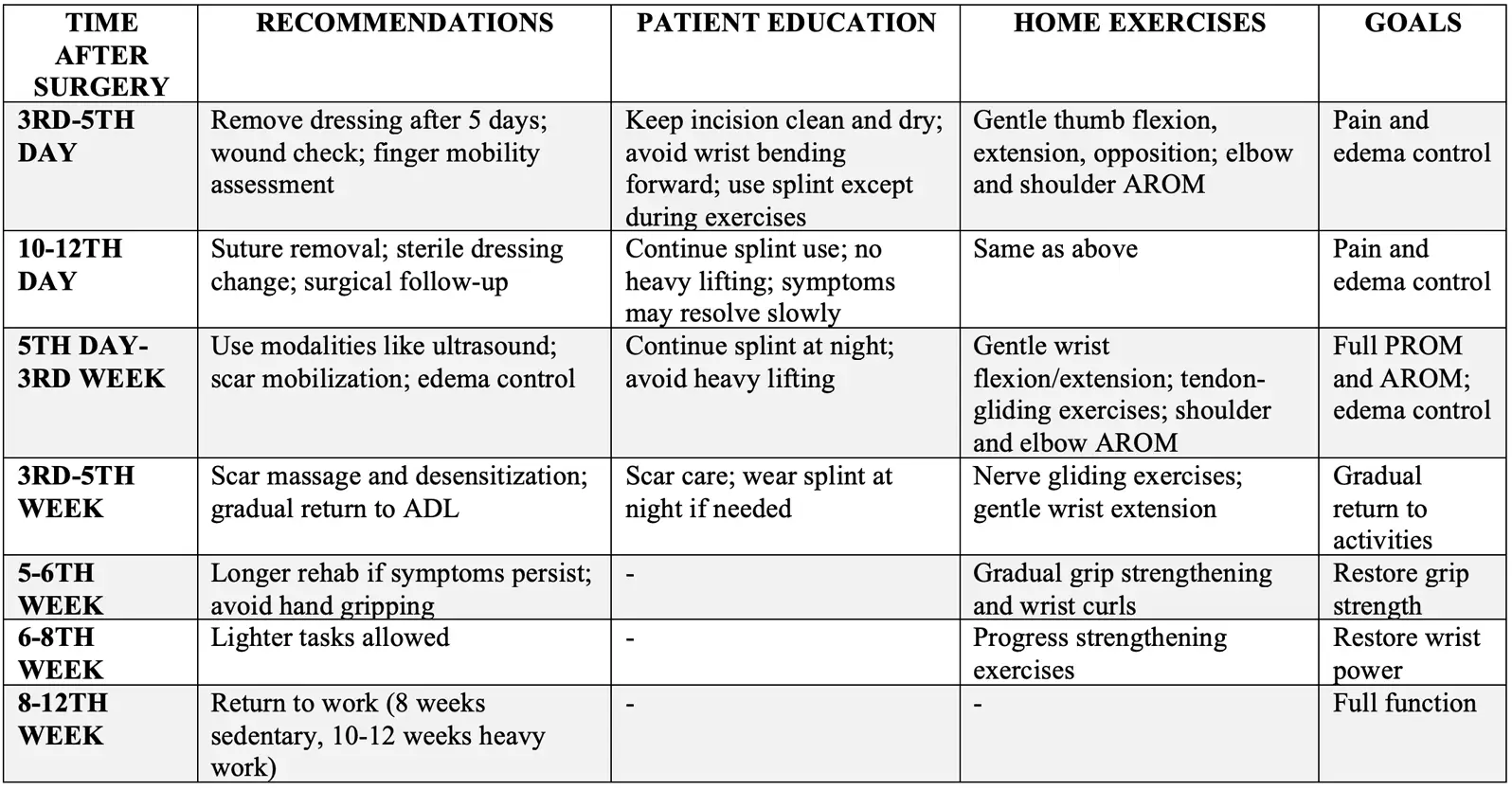
This review of postoperative management emphasizes early mobilization, patient education, scar management, gradual strengthening, and return to function while minimizing complications.
Frequently Asked Questions
1. When can I return to work after carpal tunnel surgery?
The timing of your return to work depends on the type of work you do and how your hand is recovering.
For office or computer-based work, you may be able to return relatively early with appropriate modifications. Jobs that require frequent gripping, lifting, pushing, pulling, use of tools, or repetitive hand movements may require a longer recovery period.
Your physiotherapist can help you develop a gradual return-to-work plan based on your symptoms, strength, hand function, and specific job requirements.
2. When can I start typing after carpal tunnel surgery?
Typing can generally be reintroduced gradually as your comfort allows. Short periods of typing are usually better tolerated than prolonged computer work during the early stages.
If typing increases pain, swelling, or discomfort around the incision or palm, reduce the duration and take regular breaks. An ergonomic keyboard and workstation setup may also help reduce unnecessary stress on the wrist.
The goal is to gradually increase your typing tolerance rather than returning immediately to a full day of computer work.
3. When can I drive after carpal tunnel surgery?
You should not drive until you are able to comfortably and safely control the vehicle and perform an emergency manoeuvre if necessary.
Before returning to driving, you should have adequate wrist and hand movement, sufficient grip and control, and no significant pain that could interfere with your ability to drive safely. You should also follow your surgeon’s recommendations and check with your insurance provider if required.
Start with short trips when you feel ready and gradually increase your driving time.
4. Do I need to wear a wrist splint after carpal tunnel surgery?
Not every patient needs to wear a wrist splint after carpal tunnel release.
Your surgeon or physiotherapist may recommend a splint depending on your surgical procedure, symptoms, healing, and daily activities. In many cases, prolonged immobilization is not necessary, and gentle movement is encouraged during recovery.
If a splint is recommended, it should be used according to your healthcare provider’s instructions rather than worn continuously without a specific reason.
5. When can I start using my hand normally?
Gentle use of the hand is generally encouraged as your symptoms and wound healing allow. Simple activities such as moving your fingers, using your hand for light daily tasks, and performing prescribed exercises can help restore normal movement.
However, heavy gripping, forceful pushing or pulling, and lifting should be introduced gradually. Your physiotherapist can guide you through a progressive increase in hand use based on your recovery.
6. When can I start lifting weights after carpal tunnel surgery?
Heavy lifting and forceful gripping should be avoided during the early stages of recovery. Strengthening is generally introduced progressively once the incision has healed and your hand can tolerate increased loading.
Rather than returning immediately to your previous weights, start with lighter resistance and gradually increase the load while monitoring your symptoms.
Pain or significant swelling during or after exercise is a sign that the activity may be progressing too quickly.
7. When can I return to sports after carpal tunnel surgery?
Returning to sports should be gradual and depends on the demands of your particular activity.
Activities that place significant stress on the palm or require strong gripping—such as tennis, golf, pickleball, weight training, and some cycling activities—may require additional recovery time.
Before returning to sport, you should have adequate wrist and finger movement, improving grip strength, a well-healed incision, and the ability to perform the movements required for your sport comfortably.
Your physiotherapist can help you progress from basic exercises to sport-specific activities safely.
8. Why does my palm still hurt after carpal tunnel surgery?
Some patients experience tenderness or aching in the palm after carpal tunnel release. This can occur around the surgical area and is sometimes referred to as pillar pain.
Palm or scar sensitivity does not necessarily mean that the surgery was unsuccessful. These symptoms can improve gradually as the tissues heal and your hand becomes accustomed to normal loading again.
Scar management, gradual strengthening, desensitization, and progressive use of the hand may be helpful during recovery.
9. How long does it take to regain strength after carpal tunnel surgery?
Strength does not always return immediately after surgery. Grip and pinch strength can remain reduced while the incision, surrounding tissues, and hand muscles recover.
Strengthening exercises are usually introduced progressively and increased according to your symptoms and tolerance. Your recovery may be faster or slower depending on the severity and duration of your carpal tunnel symptoms, your type of surgery, and the physical demands you place on your hand.
Reference:
- Hirata, J., Suzuki, T., Yamamoto, T., Miyazaki, Y., Ogasahara, Y., Hashizume, H., & Inoue, K. (2016). Effects of tendon and nerve gliding exercises and instructions in activities of daily living following endoscopic carpal tunnel release. Asian Journal of Occupational Therapy, 11(35-41).
- Huisstede, B. M., Randsdorp, M. S., Verhagen, A. P., Koes, B. W., & Hoogvliet, P. (2010). Carpal tunnel syndrome. Part II: Effectiveness of surgical treatments—a systematic review. Archives of Physical Medicine and Rehabilitation, 91(7), 1005-1024.
- Mack, E. M., Callinan, N. J., Reams, M., Bohn, D. C., & Chmielewski, T. L. (2017). Patient-reported outcomes after open carpal tunnel release using a standard protocol with 1 hand therapy visit. Journal of Hand Therapy, 30(1), 58-64.
- Nazarieh, M., Hakakzadeh, A., Ghannadi, S., Maleklou, F., Tavakol, Z., & Alizadeh, Z. (2020). Non-surgical management and post-surgical rehabilitation of carpal tunnel syndrome: An algorithmic approach and practical guideline. Asian Journal of Sports Medicine, 11(3), e102631.
- Multanen, J., Uimonen, M. M., Repo, J. P., Häkkinen, A., & Ylinen, J. (2021). Use of conservative therapy before and after surgery for carpal tunnel syndrome. BMC Musculoskeletal Disorders, 22, 484.
- Ostergaard, P. J., Meyer, M. A., & Earp, B. E. (2020). Non-operative treatment of carpal tunnel syndrome. Current Reviews in Musculoskeletal Medicine, 13(2), 141–147.
- Fernández-de-las-Peñas, C., Arias-Buría, J. L., Cleland, J. A., Pareja, J. A., Plaza-Manzano, G., & Ortega-Santiago, R. (2020). Manual therapy versus surgery for carpal tunnel syndrome: 4-year follow-up from a randomized controlled trial. Physical Therapy, 100(11), 1987-1996.
- Huisstede, B. M., Fridén, J., Coert, J. H., & Hoogvliet, P. (2014). European HANDGUIDE group. Carpal tunnel syndrome: hand surgeons, hand therapists, and physical medicine and rehabilitation physicians agree on a multidisciplinary treatment guideline—results from the European HANDGUIDE study. Archives of Physical Medicine and Rehabilitation, 95(12), 2253-2263.