Introduction
Shoulder instability and dislocation are common orthopedic conditions, often resulting from traumatic events affecting the glenohumeral joint—the most mobile joint in the human body. The shoulder’s inherent mobility comes at the expense of stability, relying on both static structures (glenoid labrum, capsule, ligaments) and dynamic stabilizers (rotator cuff, scapular muscles) to maintain joint congruency.
The incidence of shoulder dislocation varies from 11.2 to 23.9 per 100,000 person-years, with anterior dislocations accounting for approximately 90–96% of cases. Most dislocations occur in young, active males under 30 years, often during sports activities, especially contact or overhead sports. Recurrence rates after a primary dislocation are high, particularly in younger patients, with rates up to 72–94%, decreasing with age.
Management options include both surgical and non-surgical treatments. Non-surgical management typically involves immobilization and structured rehabilitation, focusing on restoring range of motion (ROM), dynamic stability, and muscular strength. Surgical options, such as arthroscopic Bankart repair or bone augmentation procedures (e.g., Latarjet), aim to restore static stabilizers and reduce recurrence, especially in high-risk populations or those with significant bone loss.
Return to sport (RTS) timelines differ between management strategies, with surgery generally associated with lower recurrence but longer recovery, while non-surgical management may allow earlier RTS but with higher risk of redislocation. Age, activity level, bone and soft tissue pathology, and patient-specific factors influence treatment choice and outcomes.
Rehabilitation following non-surgical management is critical to optimize outcomes, minimize recurrence, and facilitate a safe return to work, daily activities, and sport. Progression should be guided by both time and clinical criteria, including pain, ROM, strength, stability, neuromuscular control, and functional demands.
Surgical vs Non-Surgical Management
Non-Surgical Management:
- Indicated primarily for first-time dislocations, especially in patients >30 years or with less demanding activity levels.
- Initial immobilization is recommended for comfort, typically 1–3 weeks, with the position (internal vs external rotation) not conclusively shown to affect recurrence.
- Rehabilitation focuses on restoring motion, dynamic stability, muscular strength, and proprioception.
- Approximately 50% of patients treated non-surgically do not experience recurrence within 2 years.
Surgical Management:
- Recommended for younger patients (<30 years), recurrent instability, significant bone loss (>15–20%), or associated rotator cuff tears.
- Procedures include arthroscopic Bankart repair, Latarjet bone augmentation, and others tailored to pathology.
- Surgery reduces recurrence rates significantly (down to 2.4–15%), but carries risks such as nerve injury and stiffness.
- RTS after surgery typically ranges from 4–6 months, longer than non-surgical management.
- Surgical technique choice (open vs arthroscopic) is influenced by surgeon preference, patient factors, and pathology; arthroscopic repair is increasingly favored due to less morbidity.
Comparison:
Surgical management offers lower recurrence at the cost of longer rehabilitation and potential surgical complications. Non-surgical management allows earlier RTS but with a higher risk of redislocation. Decision-making should be individualized, considering age, activity level, injury severity, and patient preferences.
To know more about the most recent rehab protocol following surgical management of this injury, check our other article on shoulder stabilization surgery recovery.
Importance of Rehabilitation
Rehabilitation is paramount in both surgical and non-surgical management of shoulder instability. It addresses deficits in motion, strength, neuromuscular control, and proprioception essential for dynamic stability of the glenohumeral joint. Proper rehabilitation reduces pain, restores function, and helps prevent recurrence. For overhead athletes, specific programs focusing on scapular mechanics and rotator cuff strengthening improve outcomes.
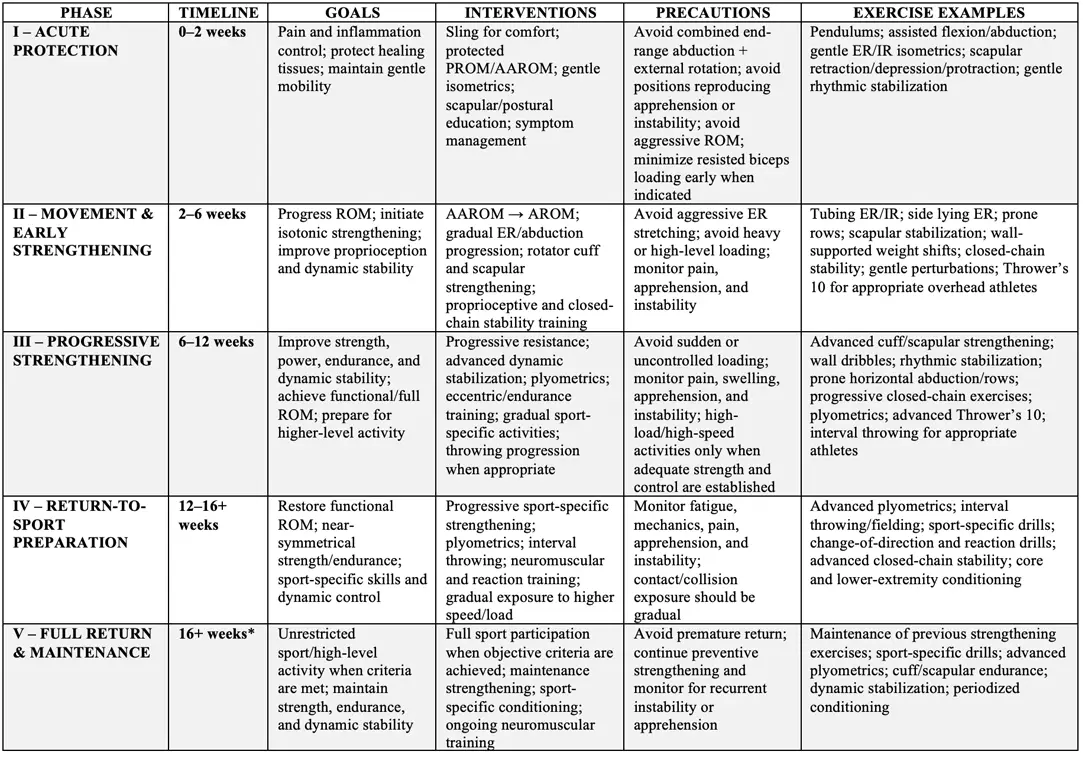
Rehabilitation Protocol: Non-Surgical Management of Shoulder Instability/Dislocation
This protocol is divided into five phases. The approximate timeframes are provided as general guidelines; progression should be individualized according to symptoms, ROM, strength, stability, neuromuscular control, functional performance, and activity demands.
This protocol is intended primarily for uncomplicated non-surgical management following reduction of a shoulder dislocation or traumatic instability episode. Patients with associated fractures, significant bone loss, rotator cuff tears, neurological injury, recurrent instability, or other significant structural pathology may require a modified or specialist-directed rehabilitation program.
Phase I: Acute Protection and Education (0–2 weeks)
Goals
- Control pain and inflammation.
- Protect healing tissues.
- Begin gentle restoration of passive ROM.
- Educate the patient on activity modification and precautions.
Interventions
- Immobilization in a sling for comfort, typically 1–3 weeks.
- Cryotherapy and other appropriate modalities to help manage pain and inflammation.
- Passive range of motion (PROM) within pain-free and protected limits, focusing on gentle flexion, abduction, and limited external/internal rotation.
- Gentle isometric contractions of the rotator cuff and scapular muscles, as tolerated.
- Postural education and scapular positioning awareness.
Precautions
- Avoid combined end-range shoulder abduction and external rotation, particularly during the early protection phase.
- Avoid positions or movements that reproduce apprehension, instability, or excessive anterior shoulder stress.
- External rotation and abduction should be progressed gradually according to irritability, stability, and clinical presentation rather than restricted to a fixed angle for every patient.
- Avoid resisted biceps loading during the early protection phase, particularly when associated labral or biceps pathology is suspected.
Exercise Examples
- Pendulum exercises.
- Rope and pulley-assisted flexion and abduction.
- Gentle assisted ROM within a protected and symptom-limited range.
- Isometric shoulder ER and IR, as tolerated.
- Scapular retraction, depression, and protraction exercises.
- Gentle rhythmic stabilization exercises as tolerated.
Posterior shoulder stretching, such as sleeper stretching or horizontal adduction, should not be routinely prescribed during the acute phase and should only be introduced when clinically indicated and tolerated.
Phase II: Movement and Early Strengthening (2–6 weeks)
Goals
- Progress ROM toward full range.
- Initiate isotonic strengthening.
- Improve neuromuscular control and dynamic stability.
- Maintain scapular and rotator cuff muscle balance.
Interventions
- Active-assisted and active ROM exercises, progressing external rotation and abduction gradually.
- Begin light isotonic strengthening for the rotator cuff and scapular muscles.
- Continue posterior shoulder flexibility work if clinically indicated.
- Proprioceptive and neuromuscular control drills.
- Core and lower extremity strengthening to support the kinetic chain.
Precautions
- Avoid aggressive external rotation stretching beyond tolerance.
- Limit overhead activities according to symptoms and stability.
- Avoid heavy loading and high-level plyometrics during this phase.
Exercise Examples
- Tubing ER/IR at 0° abduction.
- Sidelying external rotation.
- Prone rowing.
- Scapular stabilization drills.
- Core stabilization exercises.
- Joint mobilizations as indicated.
- Wall-supported weight shifts.
- Controlled closed-chain stability exercises.
- Gentle perturbation exercises as tolerated.
- Thrower’s 10 exercises for appropriate overhead athletes.
Progress resistance gradually based on symptom response, movement quality, and absence of apprehension.
Phase III: Progressive Strengthening (6–12 weeks)
Goals
- Improve strength, power, and muscular endurance.
- Enhance dynamic stability and neuromuscular control.
- Restore near-full ROM.
- Prepare the shoulder for progressively higher functional demands.
Interventions
- Continue and progressively increase resistance in strengthening exercises.
- Introduce progressive plyometric drills for the shoulder and scapula.
- Initiate light throwing or sport-specific motions when clinically appropriate.
- Emphasize eccentric control, muscular endurance, and dynamic stabilization.
- Progress from controlled closed-chain exercises to more demanding open-chain stability and perturbation exercises.
Precautions
- Avoid sudden or uncontrolled movements during early progression.
- Monitor pain, swelling, apprehension, and instability symptoms.
- Progress throwing intensity gradually.
- Higher-load and higher-speed activities should only be introduced when adequate strength, control, and stability have been demonstrated.
Exercise Examples
- Advanced rotator cuff strengthening.
- Advanced scapular stabilization exercises.
- Advanced Thrower’s 10 exercises for appropriate overhead athletes.
- Wall dribbles.
- Rhythmic stabilization with manual resistance.
- Prone horizontal abduction.
- Prone rowing.
- Stability-ball shoulder exercises.
- Progressive closed-chain shoulder stabilization.
- Dynamic perturbation exercises.
- Two-handed progressing to one-handed plyometric drills.
- Core and lumbopelvic strengthening.
- Low-intensity interval throwing for appropriate overhead athletes.
For overhead athletes, sport-specific loading and interval throwing should begin only when adequate ROM, strength, neuromuscular control, and absence of instability symptoms have been demonstrated.
Phase IV: Return to Sport Preparation (12–16 weeks)
Goals
- Restore full functional ROM.
- Achieve muscular strength and endurance comparable to the contralateral side.
- Progress sport-specific skills and proprioception.
- Prepare for gradual return to competitive activities.
Interventions
- Continue progressive strengthening and plyometric exercises.
- Advance interval throwing programs for appropriate throwing athletes.
- Progress sport-specific drills.
- Introduce batting practice for appropriate athletes.
- Progress neuromuscular control and dynamic stability drills.
- Gradually introduce higher-speed and higher-load activities according to individual sport demands.
Precautions
- Avoid excessive training volume, overuse, and fatigue.
- Ensure appropriate movement mechanics.
- Monitor for pain, apprehension, or instability.
- Contact and collision athletes should undergo a gradual progression of sport-specific contact exposure before unrestricted participation.
Exercise Examples
- Full Thrower’s 10 program for appropriate overhead athletes.
- Advanced shoulder plyometrics.
- Progressive interval throwing and fielding drills.
- Sport-specific strengthening.
- Sport-specific change-of-direction and reaction drills.
- Advanced closed-chain stability exercises.
- Dynamic perturbation exercises.
- Core and lower extremity conditioning.
Sport-specific activities should be progressed according to the patient’s individual activity demands rather than using a fixed timeline alone.
Phase V: Full Return to Activity (16+ weeks)
Goals
- Return to unrestricted sport participation or high-level activity when appropriate clinical and functional criteria have been achieved.
- Maintain strength, flexibility, and dynamic stability.
- Reduce the risk of recurrence.
Full return should be based on achievement of objective clinical and functional criteria rather than time alone.
Interventions
- Full participation in sport-specific activities when appropriate criteria have been met.
- Ongoing maintenance of strength and conditioning.
- Continued neuromuscular and dynamic stability training.
- Monitor for any signs of instability, apprehension, or discomfort.
Precautions
- Avoid rushing return to full competition.
- Continue preventive exercises and conditioning.
- Gradually increase training volume and intensity.
Exercise Examples
- Continue previous strengthening exercises as a maintenance program.
- Sport-specific performance drills.
- Advanced plyometric exercises.
- Dynamic stabilization exercises.
- Rotator cuff and scapular endurance exercises.
- Periodized strength and conditioning program.
Return-to-Sport / Return-to-Activity Criteria
Before unrestricted return to sport or high-demand activity, the patient should demonstrate:
- Full or functionally adequate ROM without pain or apprehension.
- No recurrent instability, subluxation, or dislocation episodes.
- Minimal or no pain during sport-specific loading.
- Near-symmetrical rotator cuff and scapular muscle strength compared with the contralateral side.
- Good dynamic glenohumeral and scapular control during open- and closed-chain activities.
- Ability to perform progressive sport-specific drills without pain, apprehension, or instability.
- Adequate muscular endurance and fatigue resistance for the individual’s activity demands.
- Appropriate confidence and psychological readiness to return to the required activity.
Indications for Medical / Orthopedic Reassessment
Consider referral for further medical or orthopedic assessment in patients with:
- Recurrent dislocation or subluxation despite appropriate rehabilitation.
- Persistent apprehension or instability that limits progression.
- Significant or persistent weakness.
- Suspected rotator cuff tear or significant labral pathology.
- Persistent pain or functional limitation despite appropriate rehabilitation.
- Neurological symptoms, including persistent numbness, weakness, or altered sensation.
- Suspected fracture or significant glenoid/humeral bone involvement.
- Inability to progress through rehabilitation despite appropriate treatment and adherence.
Important Clinical Consideration
This protocol provides a general framework for non-surgical rehabilitation following shoulder instability or dislocation. Rehabilitation should be individualized based on the direction and severity of instability, age, activity level, associated injuries, imaging findings, previous instability episodes, and the patient’s functional goals.
Patients with fracture-dislocations, significant bone loss, surgical stabilization, rotator cuff repair, neurological injury, or other significant structural pathology should follow a condition-specific or surgeon-directed rehabilitation protocol.
Summary Table: Rehabilitation Protocol for Non-Surgical Shoulder Instability
Important Points & New Findings
1. Immobilization Position
Immobilization is commonly performed in internal rotation because it is practical and generally well tolerated. External-rotation immobilization has not consistently demonstrated a clinically meaningful reduction in recurrence compared with conventional internal-rotation immobilization.
The duration and position of immobilization should be individualized according to injury severity, symptoms, associated injuries, age, activity demands, and clinical presentation.
2. Motor Control & Scapular Stabilization
Rehabilitation should incorporate rotator cuff strengthening, scapular motor control, proprioception, and progressive neuromuscular training. These components are important for restoring dynamic glenohumeral stability and should be progressed alongside strengthening rather than relying on strengthening alone.
Particular attention should be given to the rotator cuff, serratus anterior, middle and lower trapezius, and coordinated scapulohumeral movement.
3. Early vs. Delayed Motion
Following reduction, the timing and extent of ROM should be individualized according to injury severity, irritability, apprehension, associated injuries, and clinical presentation.
Early protected motion may help minimize stiffness, while excessive or aggressive movement—particularly into vulnerable positions—should be avoided during the early healing period.
4. Plyometric Training & Muscular Endurance
Progressive plyometric and muscular endurance training can help restore dynamic shoulder stability, power, and tolerance to repeated loading, particularly in athletes returning to overhead, throwing, or contact sports.
Progression should be gradual and based on adequate strength, movement quality, shoulder stability, and tolerance to loading.
5. Interval Throwing Programs
For throwing athletes, structured interval throwing programs allow a gradual progression of throwing distance, intensity, volume, and sport-specific demands before full return to competition.
Throwing should only begin when adequate ROM, strength, dynamic control, and shoulder stability have been established.
Frequently Asked Questions
1. How long should I wear a sling after a shoulder dislocation?
Sling use is generally recommended for comfort and protection during the first 1–3 weeks, with duration individualized according to symptoms, injury characteristics, associated injuries, and clinical presentation.
Protected movement is gradually introduced to minimize stiffness while avoiding positions that reproduce apprehension or place excessive stress on healing tissues. Immobilization is commonly performed in internal rotation.
2. When can I start moving my shoulder after a dislocation?
Gentle protected ROM can usually be introduced during the early rehabilitation period as symptoms and stability allow. The timing and extent of movement should be individualized.
Early rehabilitation should avoid combined end-range abduction and external rotation, as well as movements that reproduce apprehension or instability. ROM can then be progressively increased as pain, mobility, and shoulder control improve.
3. When can I start strengthening my shoulder?
Gentle isometric strengthening may begin during the early rehabilitation phase as tolerated, followed by progressive isotonic strengthening as pain, ROM, and stability improve.
The focus is on the rotator cuff, scapular stabilizers, and progressive dynamic shoulder control. Strengthening should progress from low-load exercises toward more demanding resistance, closed-chain, open-chain, and sport-specific activities.
4. When can I return to sports after a shoulder dislocation?
Return to sport varies according to the individual’s recovery, sport demands, and risk of reinjury. Many patients require several months before returning to unrestricted sport.
Return should be based on adequate ROM, strength, dynamic stability, sport-specific performance, and absence of pain or apprehension rather than time alone.
Athletes participating in overhead, throwing, contact, or collision sports may require additional sport-specific testing and a gradual return-to-play progression.
5. Is rehabilitation different after surgery compared with non-surgical treatment?
Yes. Postoperative rehabilitation is generally more protective initially and must account for the specific surgical procedure and tissue-healing requirements.
Non-surgical rehabilitation also requires protection during the early phase, but progression is generally guided by the individual’s symptoms, stability, ROM, strength, and functional goals.
The exact rehabilitation protocol following surgery depends on the procedure performed, such as Bankart repair, Latarjet, rotator cuff repair, or other stabilization procedures.
6. Can physiotherapy reduce the risk of another shoulder dislocation?
Rehabilitation can improve shoulder strength, dynamic stability, proprioception, movement control, and functional capacity. It may help reduce the risk of recurrent instability, although recurrence risk remains influenced by factors such as age, activity level, previous instability, and associated structural injuries.
A comprehensive rehabilitation program is particularly important for restoring the dynamic stabilizers of the shoulder and preparing the patient for their specific functional or sporting demands.
7. What is the best sleeping position after a shoulder dislocation?
During the early stages of recovery, sleeping on the back is generally the most comfortable and protective position. A pillow under the elbow and forearm can help support the shoulder and reduce strain.
Some patients may be more comfortable sleeping slightly elevated with extra pillows or in a reclined position. Avoid sleeping directly on the injured shoulder and avoid positions that place the arm into excessive abduction and external rotation or reproduce pain or apprehension.
As symptoms and shoulder stability improve, sleeping positions can gradually be modified according to comfort.
8. How long should I wear the sling?
A sling is generally used for comfort and protection during the early stage of recovery, commonly for approximately 1–3 weeks. The exact duration should be individualized based on the severity of the injury, symptoms, stability, age, associated injuries, and clinical assessment.
The sling does not necessarily need to be worn continuously once pain and stability improve. Protected movement should be gradually introduced to minimize stiffness and restore shoulder function.
Patients should follow their treating clinician’s recommendations regarding when and how to reduce sling use.
9. When can I drive after a shoulder dislocation?
Driving should generally be avoided while the shoulder is still immobilized in a sling, particularly if the injured arm is needed for steering or other essential driving tasks.
Before returning to driving, the patient should have adequate pain-free shoulder movement, sufficient strength and control to safely operate the vehicle, and the ability to perform emergency steering and braking maneuvers without significant pain or apprehension.
Medication that causes drowsiness or impaired alertness should also be avoided before driving. The timing varies depending on the injured shoulder, type of vehicle, driving demands, and individual recovery, so return to driving should be based on functional ability rather than a specific number of days.
References
- Kavaja, L., Lähdeoja, T., Malmivaara, A., & Paavola, M. (2018). Treatment after traumatic shoulder dislocation: a systematic review with a network meta-analysis. British Journal of Sports Medicine, 52(22), 1498–1506. https://doi.org/10.1136/bjsports-2017-098539
- Thacher, R. R., Varady, N. H., Khilnani, T., Camp, C. L., & Dines, J. S. (2024). Current concepts on the management of shoulder instability in throwing athletes. Current Reviews in Musculoskeletal Medicine, 17(3), 353–364. https://doi.org/10.1007/s12178-024-09910-1
- Matache, B. A., Hurley, E. T., Wong, I., Itoi, E., Strauss, E. J., Delaney, R. A., … & The Anterior Shoulder Instability International Consensus Group. (2021). Anterior shoulder instability part III: Revision surgery, rehabilitation and return to play, and clinical follow-up—An international consensus statement. Arthroscopy, 38(2), 234–242. https://doi.org/10.1016/j.arthro.2021.07.019
- Wong, C., Jaggi, A., Kearney, R., Willmore, E., Bateman, M., Maher, N., … & Gwilym, S. (2026). British Elbow and Shoulder Society practice guidelines: Rehabilitation following traumatic anterior shoulder dislocation (post-operative and non-operative care). Shoulder & Elbow, 18(3), 604–608. https://doi.org/10.1177/17585732261439731
- Carr, R. A., & Abrams, G. D. (2018). Management of acute shoulder instability: conservative treatment. Clinics in Shoulder and Elbow, 21(3), 169–175. https://doi.org/10.5397/cise.2018.21.3.169
- Warby, S. A., Ford, J. J., Hahne, A. J., Watson, L., Balster, S., Lenssen, R., & Pizzari, T. (2018). Comparison of 2 exercise rehabilitation programs for multidirectional instability of the glenohumeral joint: a randomized controlled trial. American Journal of Sports Medicine, 46(1), 87–97. https://doi.org/10.1177/0363546517734508
- McIntyre, K., Bélanger, A., Dhir, J., Somerville, L., Watson, L., Willis, M., & Sadi, J. (2016). Evidence-based conservative rehabilitation for posterior glenohumeral instability: A systematic review. Physical Therapy in Sport. https://doi.org/10.1016/j.ptsp.2016.06.002
- Fithian, A. T., Edmonds, E. W., Egger, A. C., Nissen, C. W., Bomar, J. D., Veerkamp, M. W., … & Parikh, S. N. (2024). Evaluation and management of glenohumeral instability in adolescent patients: An expert consensus statement. Orthopaedic Journal of Sports Medicine, 12(9), 23259671241271735. https://doi.org/10.1177/23259671241271735
- Friedman, L. G. M., Lafosse, L., & Garrigues, G. E. (2019). Global perspectives on management of shoulder instability: Decision making and treatment. Orthopedic Clinics of North America, 50(2), 165–183. https://doi.org/10.1016/j.ocl.2019.11.008 [[105]]
- Hasebroock, A. W., Brinkman, J., Foster, L., & Bowens, J. P. (2019). Management of primary anterior shoulder dislocations: A narrative review. Sports Medicine – Open, 5(31). https://doi.org/10.1186/s40798-019-0203-2
- Onks, C., Silvis, M., Loeffert, J., Tucker, J., & Gallo, R. A. (2021). Conservative or surgical management for that shoulder dislocation? The Journal of Family Practice, 70(2), 80–83. https://doi.org/10.12788/jfp.0156
- Alentorn-Geli, E., Brilakis, E., Ângelo, A. C., Bøe, B., Ruíz-Iban, M., Dyrna, F., … & Milano, G. (2026). Age- and time-specific management of traumatic anterior shoulder instability: The 2024 ESSKA–ESA formal consensus. Part 2: Treatment and return to sports. Knee Surgery, Sports Traumatology, Arthroscopy, 34(9), 3040–3051. https://doi.org/10.1002/ksa.70497
- Wilk, K. E., & Macrina, L. C. (2014). Nonoperative and postoperative rehabilitation for injuries of the throwing shoulder. Sports Medicine and Arthroscopy Review, 22(2), 137–150. https://doi.org/10.1097/JSA.0000000000000016
Note: This protocol is intended as a comprehensive guide synthesizing current best evidence and expert consensus. Individual rehabilitation should be tailored based on patient-specific factors, surgical details, and clinical judgment. Close communication between surgical and rehabilitation teams ensures optimal outcomes.