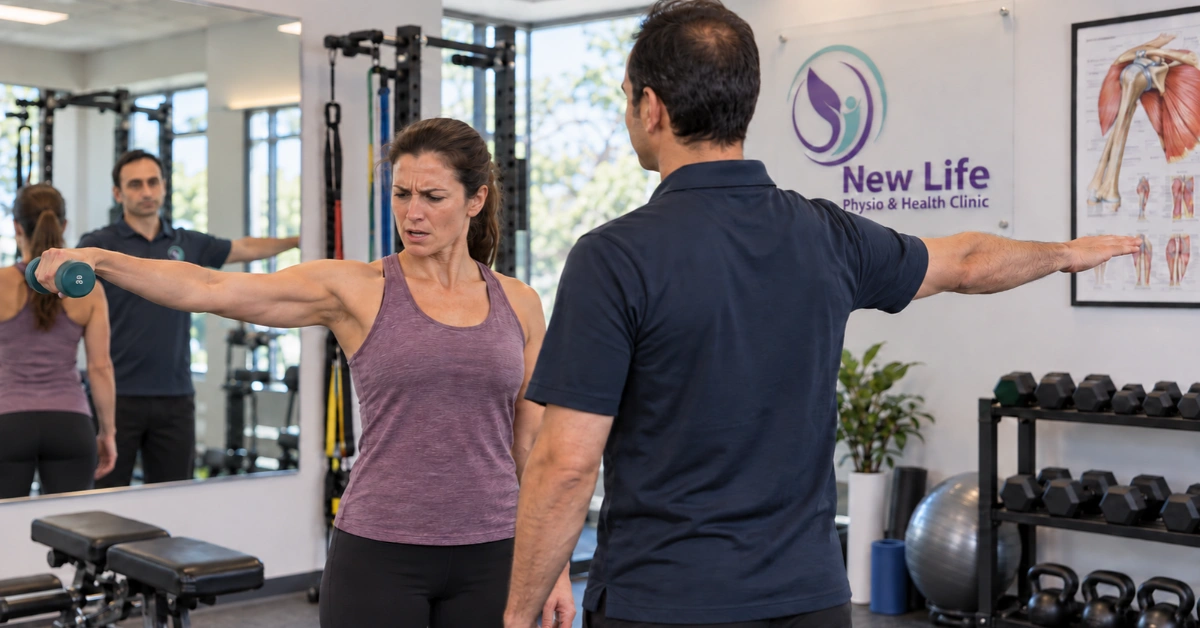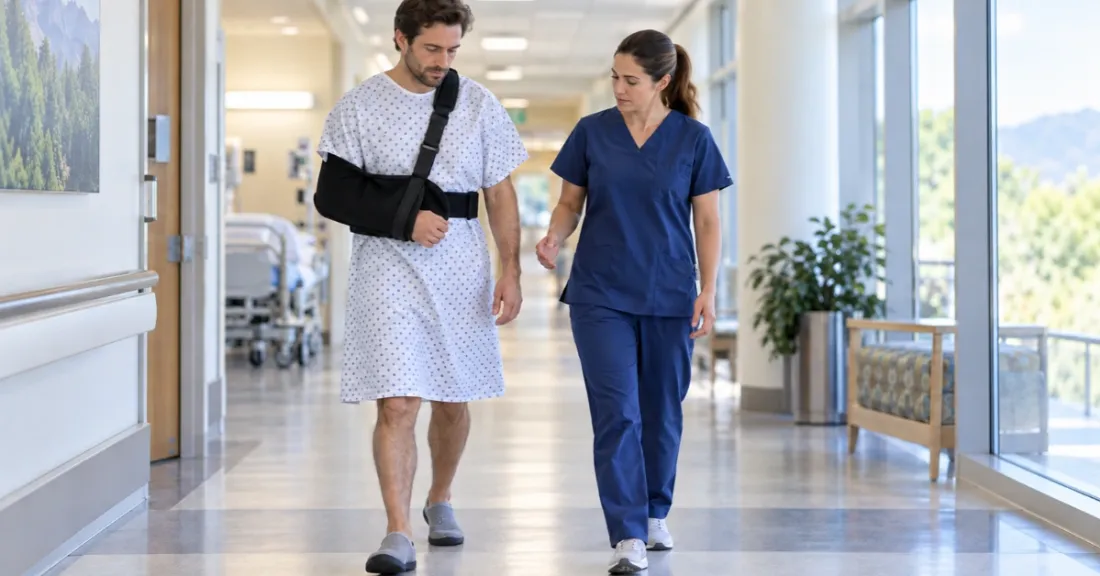
Overview of Shoulder Instability and Dislocation
The shoulder, or glenohumeral joint, is the most mobile yet inherently unstable joint in the human body. This high mobility comes at the expense of stability, making it prone to dislocations and instability events, particularly anterior dislocations, which comprise approximately 90% of shoulder dislocations. Traumatic anterior shoulder dislocations most commonly affect young, active individuals, especially males under 30 years old engaged in contact or overhead sports.
The incidence of anterior shoulder instability is highest in young, active populations, and recurrence risk is influenced by factors such as age, activity level, previous instability, sport participation, and associated bone or soft-tissue injuries.
Pathophysiology and Epidemiology
Following a dislocation, the shoulder’s static stabilizers, including the labrum, capsule, and ligaments, and dynamic stabilizers, including the rotator cuff and scapular muscles—may sustain injury.
Bankart lesions, involving injury to the anteroinferior labrum and capsulolabral complex, are common following traumatic anterior dislocation. Other associated injuries may include Hill-Sachs lesions, bony Bankart lesions, rotator cuff tears, and neurovascular injuries.
The type and extent of these injuries influence both the surgical procedure and the subsequent rehabilitation program.
Treatment Options and Decision Making
Surgical management of shoulder instability may include arthroscopic Bankart repair, open stabilization, remplissage, Latarjet or other bone-augmentation procedures, and procedures addressing associated injuries.
The choice of procedure depends on factors such as age, activity level, number of instability episodes, glenoid and humeral bone loss, soft-tissue pathology, hyperlaxity, sport demands, and previous surgery.
If you need to know more about the rehabilitation protocol following non-surgical management of this injury, check our other article on shoulder instability non-surgical rehabilitation.
Prognosis
Surgical stabilization can reduce recurrent instability in appropriately selected patients; however, recovery requires progressive rehabilitation to restore mobility, strength, neuromuscular control, confidence, and sport-specific function.
The rehabilitation timeline depends on the surgical procedure, tissue-healing requirements, associated injuries, and individual recovery. Return to sport should therefore be based on functional readiness rather than time alone.
Importance of Rehabilitation
Rehabilitation following surgical stabilization of shoulder instability is essential for restoring shoulder function, strength, proprioception, dynamic stability, and confidence.
The primary challenge is balancing protection of the surgical repair with sufficient movement and progressive loading to minimize stiffness and restore function.
A structured rehabilitation program should therefore progress from protected mobility and muscle activation to progressive strengthening, dynamic stabilization, functional training, and sport-specific activities.
Progression should be guided by both time and clinical criteria, including pain, ROM, strength, stability, movement quality, apprehension, functional performance, and the patient’s activity demands.
Rehabilitation Protocol Following Surgical Management of Shoulder Instability
Scope of This Protocol
This protocol is primarily intended for patients following uncomplicated arthroscopic anterior shoulder stabilization, particularly Bankart-type capsulolabral repair.
Rehabilitation must be modified when additional procedures or injuries are present, including:
- Latarjet or other bone-block procedures
- Remplissage
- Posterior shoulder stabilization
- Rotator cuff repair
- SLAP or biceps procedures
- Significant bone loss or fracture fixation
- Revision stabilization
- Associated neurological injury
- Other procedures with specific postoperative restrictions
The surgeon’s postoperative instructions should take priority whenever they differ from this general framework.
The following five phases provide general timeframes, but progression should be individualized according to healing, symptoms, ROM, strength, stability, neuromuscular control, functional performance, and activity demands.
Phase I: Protection and Early Mobilization
Approximate Timeline: 0–3 Weeks
Goals
- Protect the surgical repair and promote tissue healing
- Manage pain and swelling
- Minimize unnecessary stiffness
- Maintain mobility within the prescribed protected range
- Maintain activation of appropriate shoulder and scapular musculature
- Begin safe functional activities
- Educate the patient regarding precautions and activity modification
Precautions
- Use a sling for protection and comfort, commonly for up to approximately 3 weeks, although duration should be individualized according to the surgical procedure and surgeon’s instructions.
- During the immobilization period, shoulder movement should remain within the prescribed protected or “safe zone.”
- Avoid combined end-range abduction and external rotation.
- Avoid movements that reproduce apprehension, instability, or excessive anterior shoulder stress.
- Avoid aggressive stretching or attempts to rapidly restore full external rotation.
- Avoid resisted shoulder movements unless specifically permitted by the postoperative protocol.
- Avoid heavy lifting, pushing, pulling, or weight-bearing through the surgical arm.
- Avoid resisted biceps loading early when the biceps-labral complex has been involved or when otherwise restricted by the surgeon.
Interventions and Exercise Examples
- Cryotherapy for pain and swelling
- Gentle passive and active-assisted ROM within the prescribed safe range
- Protected elevation, commonly progressing toward approximately 90° as tolerated and permitted
- External rotation maintained within the surgeon-prescribed limit, often initially near neutral
- Gentle internal rotation within the protected range
- Rotator cuff isometrics when appropriate
- Scapular setting and gentle scapular mobility
- Postural education
- Functional ADLs within the protected range
Examples of appropriate early functional activities may include using utensils, lifting a light drink, simple dressing activities, and other light tasks that do not place the shoulder into vulnerable positions.
Phase II: Progressive Mobility and Early Strengthening
Approximate Timeline: 3–6 Weeks
Goals
- Gradually restore shoulder ROM
- Progress from assisted to active movement
- Initiate controlled strengthening when appropriate
- Improve scapular control and neuromuscular coordination
- Begin restoring dynamic shoulder stability
- Gradually increase functional use of the arm
Precautions
- Continue to respect surgical healing and procedure-specific ROM restrictions.
- Avoid aggressive external rotation stretching.
- Avoid forcing the shoulder into end-range abduction/external rotation.
- Avoid heavy lifting and high-load activities.
- Avoid resisted exercises before the appropriate healing milestone.
- Monitor for increasing pain, swelling, apprehension, or instability.
Interventions and Exercise Examples
- Progress AAROM toward AROM
- Gradual progression of flexion/elevation
- Progressive external and internal rotation within the prescribed limits
- Rotator cuff activation
- Scapular stabilization
- Low-load isotonic strengthening when appropriate
- Wall-supported weight shifts
- Closed-chain stability exercises
- Rhythmic stabilization
- Proprioceptive exercises
- Core and lower-extremity strengthening
- Kinetic-chain exercises
Through-range movements can generally begin around the 4-week stage when appropriate, while resisted strengthening is commonly introduced around 6 weeks, provided the surgical procedure and clinical presentation permit progression.
The Thrower’s 10 program may be incorporated selectively for overhead athletes rather than being prescribed routinely to every patient.
Phase III: Progressive Strengthening and Dynamic Stability
Approximate Timeline: 6–12 Weeks
Goals
- Improve strength and muscular endurance
- Restore dynamic glenohumeral and scapular stability
- Improve neuromuscular control
- Restore functional ROM
- Develop tolerance to progressive loading
- Begin preparation for higher-level functional activities
Precautions
- Progress resistance gradually.
- Avoid sudden or uncontrolled loading.
- Monitor for pain, swelling, apprehension, or recurrent instability.
- High-speed and high-load activities should not be introduced until adequate strength and movement control have been established.
- Throwing should not begin solely because a specific week has been reached; adequate ROM, strength, stability, and control should be demonstrated first.
Interventions and Exercise Examples
- Progressive rotator cuff strengthening
- Progressive scapular strengthening
- Advanced closed-chain stability exercises
- Open-chain dynamic stabilization
- Rhythmic stabilization with increasing resistance
- Perturbation training
- Wall dribbles
- Stability-ball exercises
- Progressive weight-bearing exercises
- Eccentric strengthening
- Muscular endurance training
- Advanced Thrower’s 10 exercises for appropriate overhead athletes
- Core and kinetic-chain strengthening
Low-level plyometric activities may be introduced progressively when adequate strength, control, ROM, and stability have been demonstrated. Higher-level unilateral and high-speed plyometrics should be introduced later as functional readiness improves.
Phase IV: Advanced Strengthening and Return-to-Sport Preparation
Approximate Timeline: 12–20+ Weeks
Goals
- Restore near-symmetrical strength and endurance
- Achieve functional ROM without pain or apprehension
- Develop high-level dynamic stability
- Restore power and rate of force development
- Prepare for sport-specific or occupational demands
- Improve confidence with progressively challenging movements
Precautions
- Avoid progression based solely on time.
- Monitor fatigue, movement quality, pain, apprehension, and instability.
- Gradually increase speed, resistance, volume, and complexity.
- Contact and collision exposure should be introduced progressively.
- Throwing athletes should follow a structured interval-throwing progression.
Interventions and Exercise Examples
- Advanced rotator cuff and scapular strengthening
- Advanced plyometric exercises
- Medicine-ball drills
- Dynamic perturbation training
- Advanced closed-chain and open-chain stabilization
- Sport-specific strengthening
- Change-of-direction and reaction drills
- Interval throwing for appropriate athletes
- Progressive long-toss and throwing drills
- Fielding and sport-specific drills
- Progressive contact preparation when appropriate
- Core and lower-extremity conditioning
For throwing athletes, interval throwing should progress gradually through distance, intensity, volume, and sport-specific demands rather than returning directly to unrestricted throwing.
Phase V: Return to Sport, High-Level Function and Maintenance
Approximate Timeline: 5–6+ Months
Goals
- Achieve unrestricted sport or high-level activity when objective criteria are met
- Maintain strength, mobility, endurance, and dynamic stability
- Restore confidence in the shoulder
- Reduce risk of recurrent instability
- Maintain sport-specific physical capacity
Precautions
- Do not use time alone as clearance for unrestricted activity.
- Continue monitoring for apprehension, pain, fatigue, or recurrent instability.
- Maintain preventive strengthening and conditioning.
- Gradually increase training volume and intensity after returning to sport.
Interventions and Exercise Examples
- Full sport-specific training
- Advanced plyometrics
- Sport-specific power and conditioning
- Advanced dynamic stabilization
- Rotator cuff and scapular endurance
- Throwing maintenance programs
- Change-of-direction and reaction drills
- Contact/collision preparation when appropriate
- Periodized conditioning
- Long-term maintenance strengthening
For soft-tissue stabilization procedures such as Bankart repair, unrestricted return to sport commonly occurs around the 6-month stage, but this is not an automatic clearance point. Earlier or later return may be appropriate depending on the procedure, sport demands, functional recovery, and objective testing.
Return-to-Sport Criteria
Return to sport should be criteria-based rather than time-based.
Before unrestricted return, the patient should demonstrate:
- Full or functionally adequate pain-free ROM
- No recurrent instability or significant apprehension
- Stable shoulder on clinical assessment
- Appropriate strength compared with the contralateral side
- Adequate rotator cuff and scapular endurance
- Good scapulohumeral movement control
- Adequate dynamic stabilization during open- and closed-chain activities
- Successful completion of sport-specific drills
- Ability to tolerate progressively higher loads, speeds, and volumes
- Adequate proprioception and reaction control
- Confidence using the surgical shoulder
- Appropriate psychological readiness
- Ability to meet the physical and functional demands of the individual’s sport
Recent consensus recommendations similarly emphasize pain-free ROM, stability, strength, sport-specific readiness, and psychological readiness rather than relying on a single postoperative time point.
Return to Work and Daily Activities
Return to work should be individualized according to the patient’s occupation and surgical procedure.
- Light desk-based work may often resume earlier if pain is controlled and the arm can remain within the prescribed protected range.
- Light functional activities can be gradually increased according to symptoms and surgical restrictions.
- Manual work involving lifting, pushing, pulling, overhead activity, or repetitive shoulder loading generally requires a longer progression.
- Heavy manual work should not resume until adequate strength, stability, ROM, and functional capacity have been restored.
A recent rehabilitation consensus supports return to light work as tolerated, with more demanding manual work generally requiring a longer rehabilitation period.
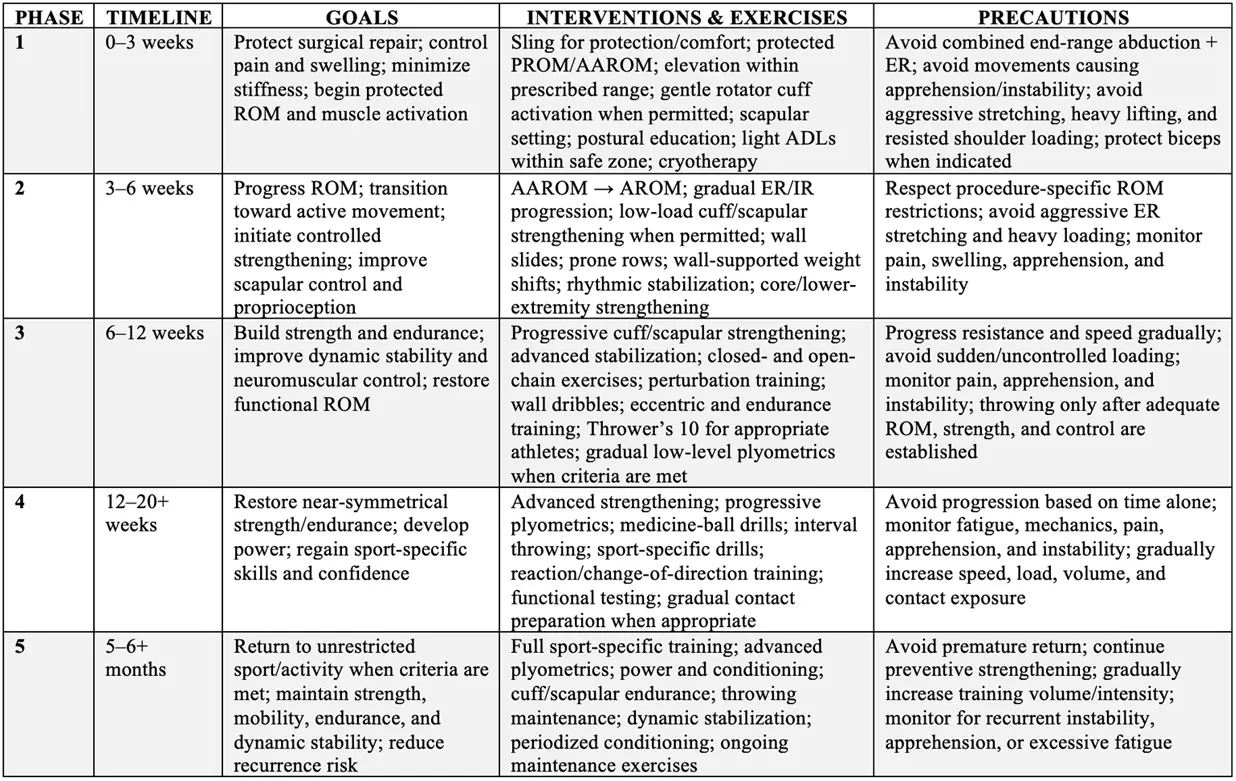
Summary Table: Rehabilitation Protocol Following Surgical Shoulder Stabilization
When Should the Patient Be Reassessed?
Further orthopedic or medical assessment should be considered if the patient develops:
- Recurrent dislocation or subluxation
- Increasing apprehension or a sensation of instability
- Unexpected or progressive loss of ROM
- Persistent or worsening pain
- Significant weakness that does not improve with rehabilitation
- New numbness, tingling, or other neurological symptoms
- Signs of infection or unusual postoperative swelling
- A sudden deterioration in function
- Inability to progress despite appropriate rehabilitation
- Any concern regarding failure or complication of the surgical repair
Additional Important Points & New Findings
Early Mobilization Within a Protected Range
Early controlled movement is generally incorporated following arthroscopic stabilization surgery, but movement should remain within a defined protected range during the initial healing period. The goal is to minimize stiffness without placing excessive stress on the repair.
Progression Should Be Criteria-Based
Timeframes provide a framework for rehabilitation but should not be treated as automatic clearance points. Pain, ROM, strength, stability, movement quality, confidence, and functional performance should influence progression.
Managing Apprehension
Postoperative apprehension is an important rehabilitation consideration following Bankart repair. Gradual exposure to previously provocative positions, combined with appropriate strengthening, motor-control training, and confidence-building strategies, can help patients regain trust in the shoulder.
Psychological Readiness
Fear of reinjury, reduced confidence, and kinesiophobia can influence rehabilitation progression and return to sport. Psychological readiness should therefore be considered alongside physical recovery.
Immobilization Duration
A sling is commonly used for up to approximately 3 weeks following arthroscopic shoulder stabilization, although it may be discontinued earlier when clinically appropriate. The exact duration should follow the surgeon’s postoperative instructions and the specific procedure performed.
Contact and Collision Sports
Return to contact or collision sports should not be based solely on reaching a specific postoperative week. Functional recovery, shoulder stability, strength, sport-specific performance, confidence, and readiness for contact should all be considered. Recent consensus supports individualized return to sport, with many soft-tissue stabilization patients returning without restriction around 6 months when appropriate criteria are achieved.
Common Patient Questions and Answers
How long will I need to wear a sling after surgery
A sling is commonly used for up to approximately 3 weeks following arthroscopic shoulder stabilization. The exact duration depends on the surgical procedure, surgeon’s instructions, tissue-healing requirements, symptoms, and clinical presentation.
The sling may be discontinued earlier when appropriate, but patients should not stop using it simply because the shoulder feels better. The treating surgeon and physiotherapist should guide progression.
When can I start moving my shoulder after surgery?
Gentle protected movement is generally introduced during the early postoperative period. The specific ROM allowed depends on the surgical procedure and surgeon’s protocol.
During the initial healing period, movement should remain within the prescribed safe range, avoiding positions that place excessive stress on the repair. Through-range movement can generally progress after the initial protection phase, with resisted movement commonly introduced around 6 weeks when appropriate.
When can I start strengthening?
Gentle muscle activation may begin early when permitted, followed by progressive strengthening as healing progresses.
Resisted strengthening is commonly introduced around the 6-week stage following uncomplicated arthroscopic stabilization, but the exact timing depends on the procedure and postoperative restrictions. Strengthening should initially emphasize the rotator cuff, scapular stabilizers, and controlled shoulder movement before progressing to heavier and higher-speed activities.
When can I return to sports?
Return to sport varies considerably depending on the surgical procedure, type of sport, rehabilitation progress, and individual recovery.
Many patients following soft-tissue stabilization require approximately 4–6 months before returning to unrestricted sport, with contact, collision, and high-level overhead sports often requiring a more cautious progression. Return should be based on objective functional recovery rather than time alone.
Is early movement safe?
Controlled early movement can be appropriate following surgery when performed within the prescribed rehabilitation limits.
Early protected movement can help minimize stiffness while allowing the surgical tissues to heal. However, the specific ROM restrictions must be individualized according to the surgical procedure and surgeon’s instructions.
What exercises will I do during rehabilitation?
Rehabilitation typically progresses from protected ROM and gentle muscle activation to active ROM, progressive strengthening, dynamic stabilization, plyometrics, and sport-specific training.
Exercise selection depends on the surgical procedure, stage of healing, symptoms, strength, stability, functional goals, and sport or occupational demands. The Thrower’s 10 program may be incorporated for appropriate overhead athletes but is not required for every patient.
When can I sleep on my operated shoulder?
Sleeping directly on the operated shoulder is generally avoided during the early healing period. Sleeping on the back or on the opposite side with the operated arm supported by a pillow is often more comfortable.
As healing progresses and the shoulder becomes more comfortable and stable, sleeping positions can gradually be modified according to symptoms and the surgeon’s recommendations.
When can I drive after surgery?
Driving should generally be avoided while the shoulder is immobilized in a sling and while pain, limited ROM, or medication could interfere with safe vehicle control.
Before returning to driving, the patient should have adequate functional ROM and strength to safely control the steering wheel and perform emergency maneuvers without significant pain or apprehension. The timing depends on the surgical procedure, side of surgery, type of vehicle, driving demands, and individual recovery.
When can I return to work?
Return to work depends heavily on the type of work.
Desk-based work may often resume earlier if the arm can remain within the prescribed protected range and symptoms are controlled. Manual work involving lifting, pushing, pulling, overhead activity, or repetitive shoulder use generally requires a longer rehabilitation period.
Return should be based on the physical demands of the job and the patient’s functional capacity rather than a fixed date.
Will my shoulder be as strong and stable as before?
Many patients regain substantial strength, stability, and functional capacity following appropriate surgical stabilization and rehabilitation.
However, recovery varies depending on the type and extent of the original injury, surgical procedure, associated injuries, rehabilitation progression, activity demands, and individual factors.
Consistent rehabilitation and a gradual return to higher-level activities are important for maximizing functional recovery.
Reference:
- Kavaja, L., Lähdeoja, T., Malmivaara, A., & Paavola, M. (2018). Treatment after traumatic shoulder dislocation: A systematic review with a network meta-analysis. British Journal of Sports Medicine, 52(23), 1498–1506. https://doi.org/10.1136/bjsports-2017-098539
- Thacher, R. R., Varady, N. H., Khilnani, T., Camp, C. L., & Dines, J. S. (2024). Current concepts on the management of shoulder instability in throwing athletes. Current Reviews in Musculoskeletal Medicine, 17(3), 353–364. https://doi.org/10.1007/s12178-024-09910-1
- Matache, B. A., Hurley, E. T., Wong, I., Itoi, E., Strauss, E. J., Delaney, R. A., … & The Anterior Shoulder Instability International Consensus Group. (2021). Anterior shoulder instability part III: Revision surgery, rehabilitation and return to play, and clinical follow-up—An international consensus statement. Arthroscopy, 38(2), 234–242. https://doi.org/10.1016/j.arthro.2021.07.019
- Wang, S. I. (2018). Management of the first-time traumatic anterior shoulder dislocation. Clinics in Shoulder and Elbow, 21(3), 169–175. https://doi.org/10.5397/cise.2018.21.3.169
- Fithian, A. T., Edmonds, E. W., Egger, A. C., Nissen, C. W., Bomar, J. D., Veerkamp, M. W., … & Parikh, S. N. (2024). Evaluation and management of glenohumeral instability in adolescent patients: An expert consensus statement. Orthopaedic Journal of Sports Medicine, 12(9), 23259671241271735. https://doi.org/10.1177/23259671241271735
- Friedman, L. G. M., Lafosse, L., & Garrigues, G. E. (2019). Global perspectives on management of shoulder instability: Decision making and treatment. Orthopedic Clinics of North America. https://doi.org/10.1016/j.ocl.2019.11.008
- Wilk, K. E., & Macrina, L. C. (2014). Nonoperative and postoperative rehabilitation for injuries of the throwing shoulder. Sports Medicine and Arthroscopy Review, 22(2), 137–150. https://doi.org/10.1097/JSA.0000000000000035
- Wong, C., Jaggi, A., Willmore, E., Maher, N., Bateman, M., O’Sullivan, J., … & Chester, R. (2026). Critical evidence synthesis on rehabilitation following arthroscopic shoulder stabilisation surgery for traumatic anterior instability: Consensus recommendations for clinical practice and research. British Journal of Sports Medicine, 60(2), 98–107. https://doi.org/10.1136/bjsports-2025-109674
- Willmore, E., Bateman, M., Maher, N., Chester, R., O’Sullivan, J., Blacknall, J., … & Jaggi, A. (2024). Rehabilitation guidelines following arthroscopic shoulder stabilisation surgery for traumatic instability – a Delphi consensus. Physiotherapy, 124, 154–163. https://doi.org/10.1016/j.physio.2024.05.001
- Hasebroock, A. W., Brinkman, J., Foster, L., & Bowens, J. P. (2019). Management of primary anterior shoulder dislocations: A narrative review. Sports Medicine – Open, 5(31). https://doi.org/10.1186/s40798-019-0203-2
- Onks, C., Silvis, M., Loeffert, J., Tucker, J., & Gallo, R. A. (2021). Conservative or surgical management for that shoulder dislocation? The Journal of Family Practice, 70(2), 80–85. https://doi.org/10.12788/jfp.0156
- Alentorn-Geli, E., Brilakis, E., Ângelo, A. C., Bøe, B., Ruíz-Iban, M., Dyrna, F., … & Beaufils, P. (2026). Age- and time-specific management of traumatic anterior shoulder instability: The 2024 ESSKA–ESA formal consensus. Part 2: Treatment and return to sports. Knee Surgery, Sports Traumatology, Arthroscopy, 34(9), 3040–3051. https://doi.org/10.1002/ksa.70497
- Fithian, A. T., Edmonds, E. W., Egger, A. C., Nissen, C. W., Bomar, J. D., Veerkamp, M. W., … & Parikh, S. N. (2024). Evaluation and management of glenohumeral instability in adolescent patients: An expert consensus statement. Orthopaedic Journal of Sports Medicine, 12(9). https://doi.org/10.1177/23259671241271735
Note: This protocol is intended as a comprehensive guide synthesizing current best evidence and expert consensus. Individual rehabilitation should be tailored based on patient-specific factors, surgical details, and clinical judgment. Close communication between surgical and rehabilitation teams ensures optimal outcomes.