


Introduction
Elbow Arthroplasty Overview
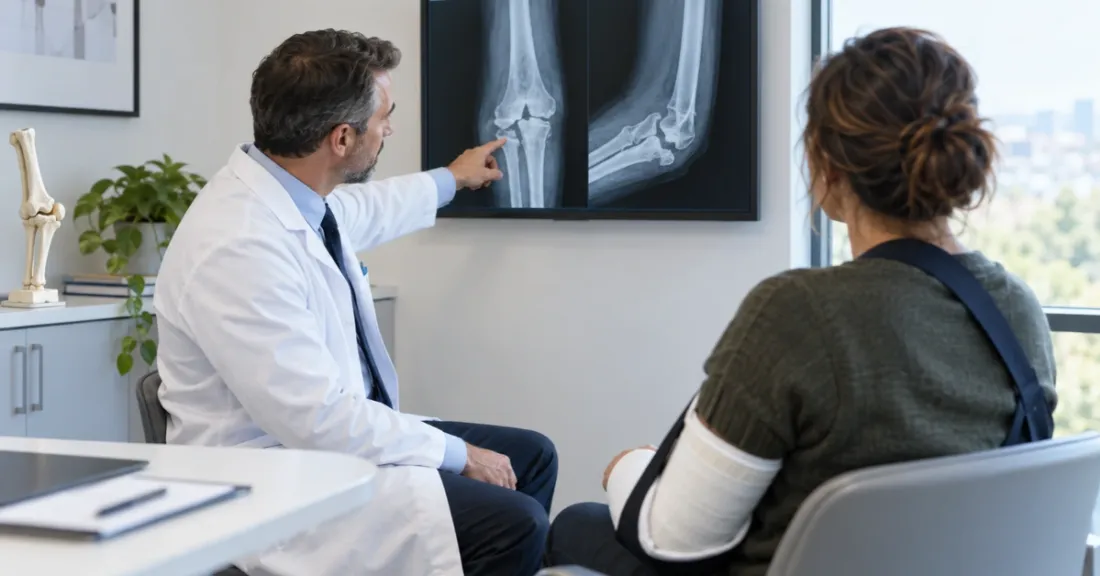
Total Elbow Arthroplasty (TEA) is a surgical procedure designed to replace the damaged elbow joint with prosthetic components. It is primarily indicated for patients with end-stage elbow arthritis, including rheumatoid arthritis, post-traumatic arthritis, osteoarthritis, and unreconstructable distal humeral fractures. Although initially developed to address rheumatoid arthritis, the indications for TEA have expanded over time to encompass a broader spectrum of elbow pathologies.
Epidemiology and Trends
TEA remains less commonly performed compared to hip or knee arthroplasty, with utilization rates significantly lower in the general population. However, its use has nearly doubled between 1998 and 2011 in the United States, reflecting expanding indications, especially for trauma-related conditions. Despite improvements, TEA still presents higher complication and revision rates compared to other joint replacements, with aseptic loosening being the leading cause of failure.
Treatment Options
Treatment options for elbow pathology vary depending on severity and include conservative management, arthroscopic procedures, hemiarthroplasty, and total elbow arthroplasty (TEA). TEA is reserved for cases where joint-preserving procedures are insufficient, offering pain relief and improved function at the cost of implant longevity concerns, especially in younger and more active patients.
Importance of Rehabilitation Post-Elbow Arthroplasty
Rehabilitation following TEA is critical to optimize functional outcomes, minimize complications such as stiffness, instability, triceps insufficiency, and nerve palsy, and to maximize implant longevity. Rehabilitation protocols vary widely due to differences in implant design (linked vs. unlinked), surgical approach (triceps-sparing vs. triceps-detaching), and patient factors. Early mobilization balanced with protection of surgical repairs is vital to prevent elbow contractures and promote recovery.
Rehabilitation Protocol
Phase 1: Immediate Postoperative Phase (Day 0 to 2 Weeks)
Goals:
- Protect surgical site and soft tissues
- Control pain and swelling
- Prevent stiffness through controlled mobilization
- Protect triceps tendon and repaired ligaments
Interventions:
- Immobilization with a removable splint or collar and cuff (linked implants) in a comfortable position (typically 80–90° flexion)
- Edema control via elevation, icing, and compression bandaging
- Gentle hand and shoulder range of motion (ROM) exercises initiated immediately to prevent compensatory stiffness
- Passive elbow mobilization allowed in the triceps-sparing approach; immobilization more common after triceps-detaching approaches
- Begin gravity-assisted elbow extension exercises if triceps repair was performed
- Patient education on activity restrictions, including lifelong lifting limitations (commonly 5 lb for linked TEA)
Precautions:
- Avoid active elbow extension if triceps tendon was detached and repaired
- Limit forearm pronation/supination if ligaments were repaired
- Avoid varus-valgus stresses to protect ligamentous repairs
- Monitor for signs of nerve irritation, especially ulnar nerve
Exercises:
- Hand gripping and finger ROM exercises
- Shoulder pendulum and active ROM exercises
- Passive elbow flexion-extension within pain-free limits (if triceps-sparing)
- Gravity-assisted elbow extension (if triceps repair)
Important Points:
- Early mobilization is encouraged to prevent elbow stiffness but must be balanced with protection of soft tissue repairs
- Lifelong lifting restrictions are generally recommended; patient compliance is often poor and should be reinforced
Phase 2: Early Rehabilitation Phase (2 to 6 Weeks)
Goals:
- Increase elbow ROM gradually
- Continue edema and pain management
- Begin gentle active motion of the elbow
- Protect triceps and ligament repairs
- Prevent development of flexion contractures
Interventions:
- Discontinue immobilization or progressively decrease use of splints/brace
- Increase active and passive elbow flexion and extension ROM exercises, avoiding excessive stress
- Initiate gentle isometric strengthening of surrounding musculature, excluding resisted elbow extension if triceps repair
- Begin scar management and edema control
- Begin gentle forearm pronation/supination within protected range
- Supervised physiotherapy sessions with focus on controlled motion
Precautions:
- Avoid repetitive lifting >1.5 kg; lifting limits usually maintained at 5 lbs or less
- Avoid elbow hyperextension and varus/valgus stresses
- Protect triceps repair; active extension against resistance avoided
- Monitor for ulnar nerve symptoms; adjust therapy accordingly
Exercises:
- Active-assisted and active elbow flexion/extension within ROM goals
- Forearm pronation and supination at 90° elbow flexion
- Isometric wrist and shoulder strengthening
- Gentle grip strengthening
Important Points:
- Nighttime elbow extension splinting may be used to prevent flexion contractures
- Patient education on adherence to weight-bearing restrictions remains crucial
Phase 3: Intermediate Rehabilitation Phase (6 to 12 Weeks)
Goals:
- Achieve functional elbow ROM (flexion-extension arc of ~100°)
- Initiate progressive strengthening of elbow and forearm muscles
- Improve triceps strength and endurance
- Begin functional use of the upper extremity within limits
Interventions:
- Discontinue bracing unless instability or ligament repair necessitates continued protection
- Initiate gentle isotonic strengthening exercises for elbow flexors, extensors, wrist and shoulder muscles
- Gradually introduce resisted elbow extension exercises (careful progression)
- Continue passive stretching and consider static progressive splinting for persistent stiffness
- Scar massage and soft tissue mobilization as needed
Precautions:
- Avoid heavy lifting (>5 lbs) and repetitive lifting (>1.5 kg)
- Avoid high varus-valgus torque and rapid loading
- Monitor pain and inflammation; adjust therapy to prevent overuse
Exercises:
- Active flexion-extension and pronation-supination exercises with progressive resistance
- Triceps strengthening with gravity-assisted and light resistance
- Functional task simulation within allowed limits (e.g., light carrying, grooming)
Important Points:
- Patient motivation and education about activity modification are paramount to implant longevity
- Frequent clinical reassessment is recommended to monitor progress and complications
Phase 4: Advanced Strengthening and Return to Activity Phase (3 to 6 Months)
Goals:
- Restore maximal safe strength and endurance
- Achieve near-normal function in activities of daily living (ADLs)
- Prepare for possible return to low to moderate demand recreational activities
Interventions:
- Progressive resistance training focusing on elbow and shoulder musculature
- Functional training addressing ADLs and occupational tasks
- Gradual introduction of moderate-demand activities under supervision
Precautions:
- Maintain lifelong lifting restrictions (commonly 5–10 lbs for linked TEA; possibly higher for unlinked)
- Avoid high-impact sports and activities causing repetitive joint loading
- Continue to monitor for signs of implant loosening or soft tissue compromise
Exercises:
- Progressive resistance exercises for elbow flexion, extension, pronation, and supination
- Functional strengthening (carrying light groceries, gardening, etc.)
- Closed kinetic chain exercises avoiding excessive joint compression
Important Points:
- Approximately 40% of patients engage in high-demand activities despite recommendations
- Return to sports is variable; low-impact activities are generally safe, high-impact discouraged
Phase 5: Long-Term Maintenance Phase (6 Months and Beyond)
Goals:
- Maintain functional range of motion and strength
- Prevent implant failure by adherence to activity modifications
- Monitor and manage late complications if they arise
Interventions:
- Encourage continued compliance with lifting and activity restrictions
- Annual or biannual clinical and radiographic evaluations to monitor implant status
- Patient education on recognizing signs of loosening, infection, or nerve issues
Precautions:
- Avoid lifting heavy objects (>5–10 lbs lifelong depending on implant type)
- Avoid repetitive high-load activities and impact sports
- Promptly report new symptoms to healthcare provider
Exercises:
- Regular low-impact strengthening and flexibility exercises
- Maintenance of ADLs and recreational activities within limits
Important Points:
- Implant survival varies by indication and implant design; highest failure rates in younger and trauma patients
- Patient compliance with restrictions is critical to prolong implant life
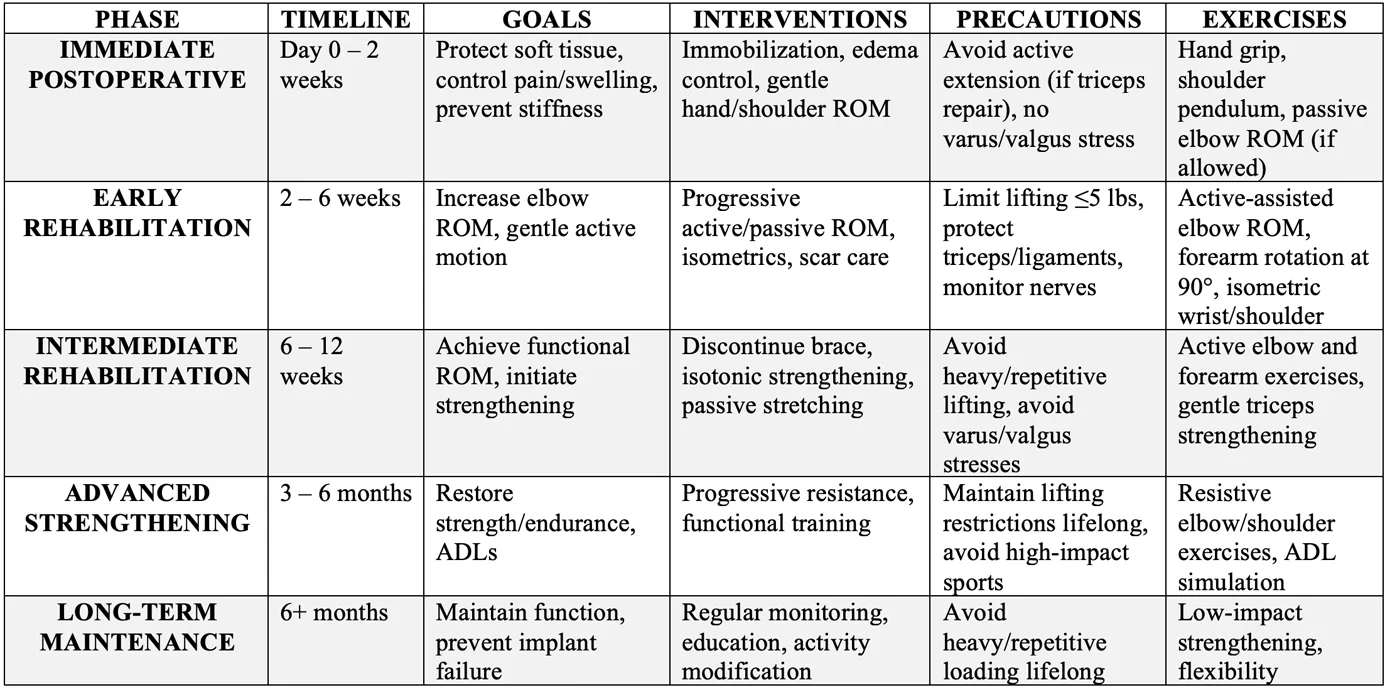
Summary Table: Rehabilitation Protocol After Elbow Arthroplasty
Additional Important Points
- Weight-Bearing Restrictions: Most surgeons recommend lifelong lifting limitations, often 5 lbs for linked TEA and 10 lbs for unlinked TEA. However, compliance is variable, with a significant number of patients performing higher-demand activities postoperatively.
- Activity Recommendations: Low-impact activities such as gardening, carrying groceries, and light household tasks are generally safe; high-impact and repetitive strenuous activities (e.g., heavy lifting, chopping wood, snow shoveling) are discouraged due to risk of implant failure.
- Triceps Repair: Surgical approach influences rehabilitation. Triceps-sparing approaches allow earlier mobilization without extension restrictions, whereas triceps-detaching approaches require protection of the triceps repair during early phases.
- Nerve Management: Ulnar nerve should be monitored throughout rehabilitation. Paresthesia or nerve symptoms require adjustment of therapy.
- Implant Survivorship: Implant survival is better for rheumatoid arthritis patients than for trauma-related cases. Younger, obese, and male patients have higher complication and revision rates.
Return to Sports and Activities Post-Elbow Arthroplasty
Activity Type | Percentage of Patients Engaging | Recommendations |
|---|---|---|
Low-Demand (e.g., cooking, driving) | >90% | Generally safe |
Moderate-Demand (e.g., gardening, hiking) | ~94% | Allowed with caution |
High-Demand (e.g., snow shovelling, chopping wood) | ~40% | Generally discouraged due to implant wear risk |
Frequently Asked Questions
1. How soon can I start moving my elbow after total elbow arthroplasty?
Depending on your surgical approach, gentle elbow movement may begin within the first few days after surgery, especially if the triceps tendon was preserved. Your therapist will guide you on safe exercises to prevent stiffness while protecting the repair.
2. What activities should I avoid after elbow replacement?
Avoid heavy lifting (usually no more than 5 to 10 pounds lifelong), repetitive strenuous activities, and high-impact sports to reduce the risk of implant loosening and failure.
3. How long will I need physiotherapy after elbow arthroplasty?
Rehabilitation typically lasts 3 to 6 months, with supervised therapy focusing on restoring motion and strength. Some patients may continue maintenance exercises lifelong.
4. Is it normal to have pain after elbow replacement?
Most patients experience significant pain relief after surgery. Mild intermittent pain can occur during activity but should improve with therapy.
5. Can I return to sports after total elbow arthroplasty?
Low-impact sports like swimming and golf are generally allowed. High-impact or heavy-contact sports are discouraged. Approximately 40% of patients resume moderate to high-demand activities, but you should discuss your specific goals with your surgeon.
6. What are the risks of complications after elbow replacement?
Common risks include implant loosening, infection, nerve issues, and triceps weakness. Following your rehabilitation protocol and activity restrictions helps minimize these risks.
References
- Wang, J.-H., Ma, H.-H., Chou, T.-F. A., Tsai, S.-W., Chen, C.-F., Wu, P.-K., & Chen, W.-M. (2019). Outcomes following total elbow arthroplasty for rheumatoid arthritis versus post-traumatic conditions: A systematic review and meta-analysis. Bone & Joint Journal, 101-B(12), 1489–1497. https://doi.org/10.1302/0301-620X.101B12.BJJ-2019-0799.R1
- Barlow, J. D., Morrey, B. F., O’Driscoll, S. W., Steinmann, S. P., & Sanchez-Sotelo, J. (2013). Activities after total elbow arthroplasty. Journal of Shoulder and Elbow Surgery, 22(6), 787–791. https://doi.org/10.1016/j.jse.2013.01.023
- Eilertsen, L., Brekke, I. F., Haavardsholm, E., Storrønning, I., Sand, S. M. U., Husby, I. E., Sexton, J., Martinsen, M. I., Valland, H., Lillegraven, S., & Fraser, A. N. (2026). Cohort of 101 consecutive Nexel total elbow arthroplasties. Journal of Shoulder and Elbow Surgery. https://doi.org/10.1016/j.jse.2026.01.021
- De Crescenzo, A., Bellato, E., D’Ambrosi, R., Bullitta, G., Cecere, A. B., Corona, K., Fogliata, V., Micheloni, G. M., Saccomanno, M. F., Vitullo, F., Celli, A., & Garofalo, R., & SICSeG Research Committee. (2025). Postoperative weightlifting restrictions following elbow arthroplasty: A survey of Italian Society of Shoulder and Elbow Surgery members. Journal of Clinical Medicine, 14(5), 1577. https://doi.org/10.3390/jcm14051577
- van Dam, W., Meijering, D., Stevens, M., Boerboom, A. L., & Eygendaal, D. (2022). Postoperative management of total elbow arthroplasty: Results of a European survey among orthopedic surgeons. PLoS ONE, 17(11), e0277662. https://doi.org/10.1371/journal.pone.0277662
- Burden, E. G., Evans, J. P., & Smith, C. D. (2023). Lifting limitations following elbow arthroplasty: A survey of British Elbow and Shoulder Society members. Shoulder & Elbow. https://doi.org/10.1177/17585732231170292
- Park, S.-E., Kim, J.-Y., Cho, S.-W., Rhee, S.-K., & Kwon, S.-Y. (2013). Complications and revision rate compared by type of total elbow arthroplasty. Journal of Shoulder and Elbow Surgery, 22(8), 1121–1127. https://doi.org/10.1016/j.jse.2013.03.003
- Verstuyft, L., Caekebeke, P., & van Riet, R. (2021). Postoperative rehabilitation in elbow surgery. Journal of Clinical Orthopaedics and Trauma, 20, 101479. https://doi.org/10.1016/j.jcot.2021.101479
- Welsink, C. L., Lambers, K. T. A., van Deurzen, D. F. P., Eygendaal, D., & van den Bekerom, M. P. J. (2017). Total elbow arthroplasty: A systematic review. JBJS Reviews, 5(7), e4. https://doi.org/10.2106/JBJS.RVW.16.00089
- Prkić, A., van Bergen, C. J. A., The, B., & Eygendaal, D. (2016). Total elbow arthroplasty is moving forward: Review on past, present and future. World Journal of Orthopedics, 7(1), 44–49. https://doi.org/10.5312/wjo.v7.i1.44
- Zhang, D., & Chen, N. (2018). Total elbow arthroplasty. Journal of Hand Surgery (American Volume). https://doi.org/10.1016/j.jhsa.2018.11.005
- Szekeres, M., & King, G. J. W. (2006). Total elbow arthroplasty. Journal of Hand Therapy, 19(3), 245–254. https://doi.org/10.1197/j.jht.2006.02.010
This comprehensive protocol integrates current evidence and expert opinion to guide rehabilitation professionals and patients through the stages of recovery following elbow arthroplasty, emphasizing the balance between early mobilization and protection to optimize outcomes.