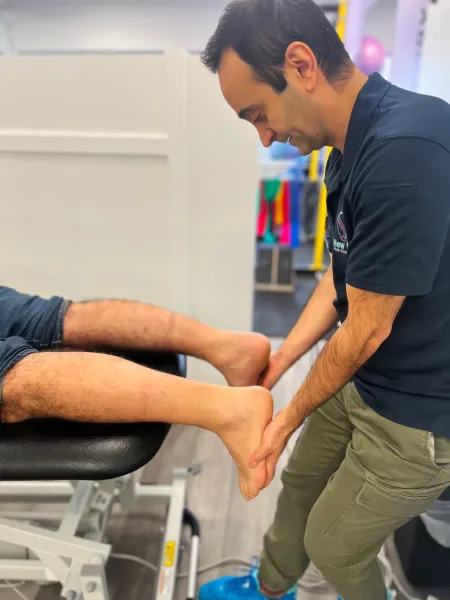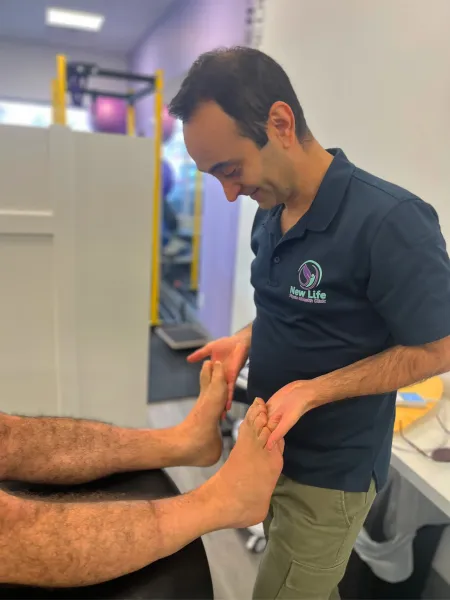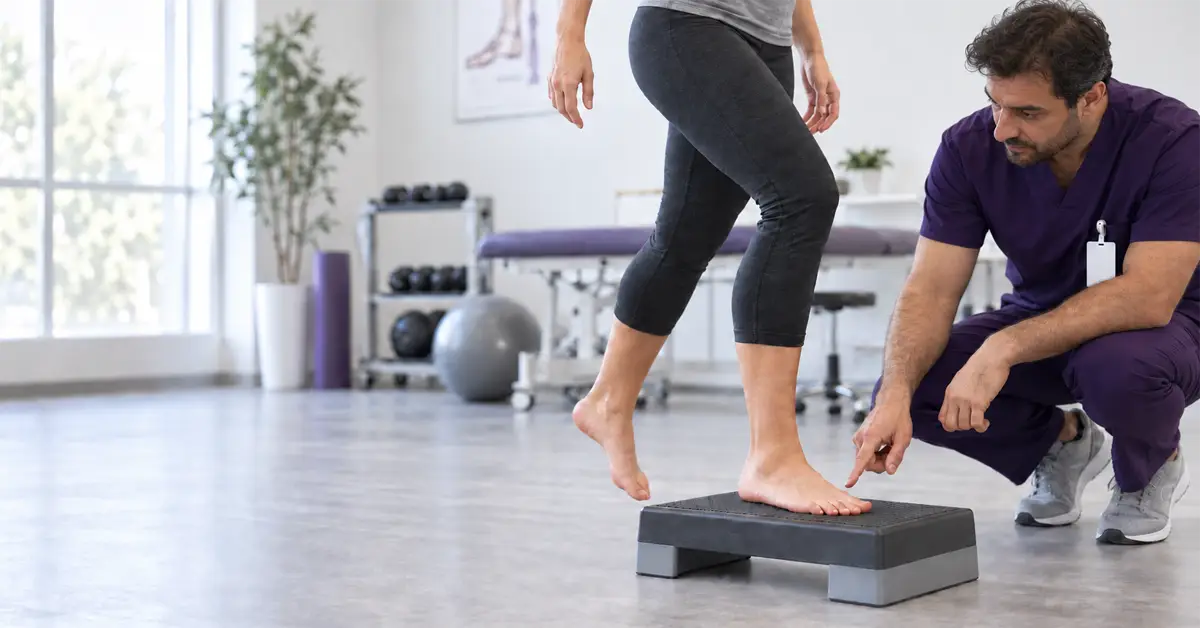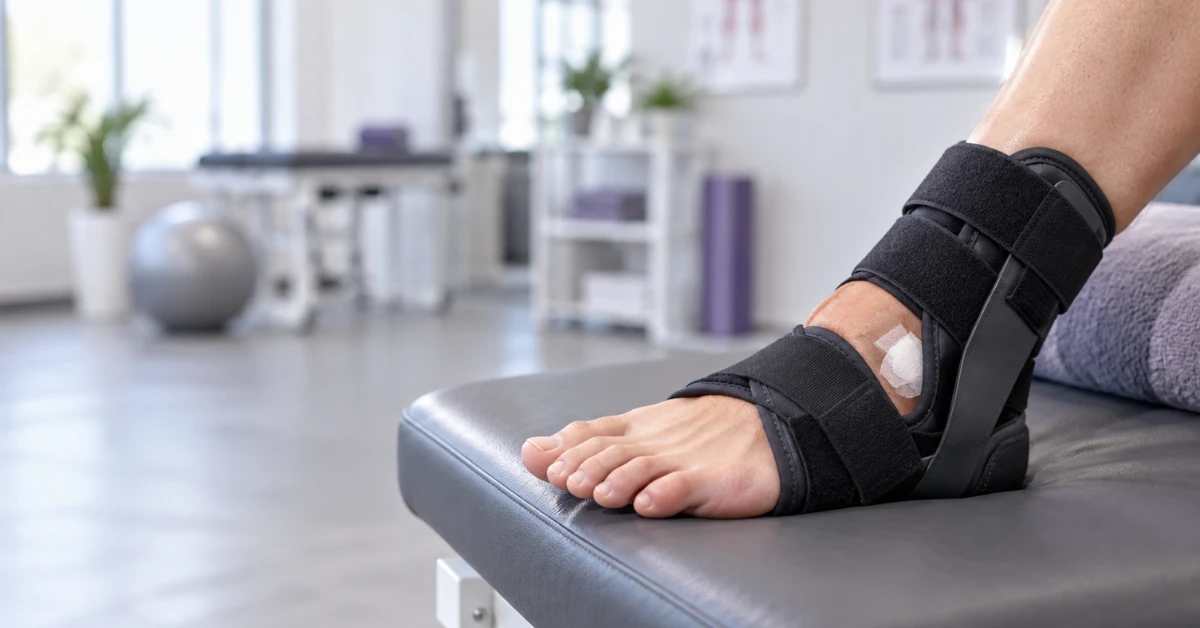
Achilles tendon rupture is one of the most common lower-leg injuries and can be managed either operatively or conservatively. Not sure if surgery is the best option for an Achilles tendon rupture? Read our full article on this topic:
Operative vs Non-operative Management of Acute Achilles Tendon Rupture.
This Comprehensive Rehabilitation Protocol for Non-Operative Management of Acute Achilles Tendon Rupture outlines an evidence-based, criterion-driven approach to help clinicians and patients navigate safe, structured recovery. It provides clear timelines, functional milestones, and progressions designed to protect tendon healing while restoring strength, mobility, and confidence through every phase of rehab.
Protection Phase
Movement Restoration
Strength Development
Return to Activity
Stage 1: Acute Phase (0–2 Weeks)
Goal
- Protect the healing tendon
- Minimize tendon elongation
- Control pain and swelling
- Prevent muscle atrophy and joint stiffness
Interventions
- Immobilize the ankle in maximum passive plantar flexion (equinus position) to approximate tendon ends
- Strict non-weight-bearing with crutches
- Patient education on injury and importance of compliance
Immobilization
- Plaster cast or rigid immobilization in maximum plantar flexion (typically 20°–30° plantar flexion) as per orthopedic team recommendation
- No weight-bearing allowed
Precautions
- No weight-bearing on affected limb
- Avoid dorsiflexion beyond plantar flexed position to prevent tendon elongation
- Monitor for signs of deep vein thrombosis (DVT)
- Educate patient on safe use of crutches and fall prevention
Sample Exercises for Physiotherapists
- Isometric exercises for the knee and hip (e.g., quadriceps sets, straight leg raises) without ankle involvement
- Non-weight-bearing cardiovascular exercises (e.g. Upper Body Ergometer)
- Upper body strengthening exercises
Stage 2: Early Mobilization Phase (2–6 Weeks)
Goal
- Gradual restoration of ankle motion to neutral
- Progressive weight-bearing to stimulate tendon healing
- Maintain cardiovascular fitness and prevent muscle atrophy
- Continue pain and swelling control
Interventions
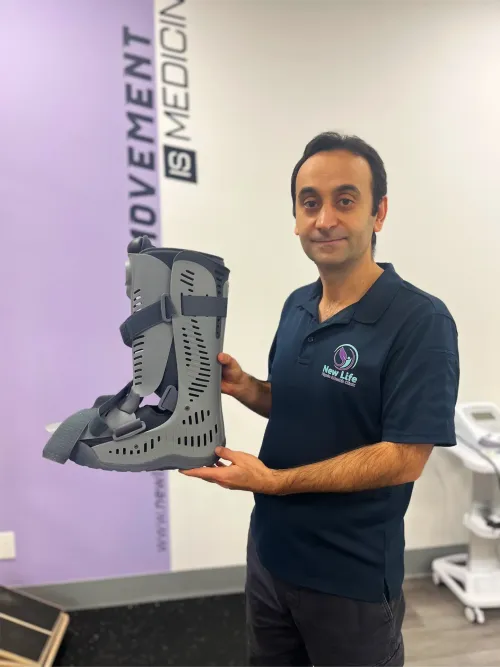
- Transition from Cast to an Achilles-specific walking boot with heel wedges (usually 40° heel lifts initially)
- Initiate protected partial weight-bearing, progressing by approximately 25% body weight per week (25% at weeks 2–3, 50% at weeks 3–4, 75% at weeks 4–5, 100% at weeks 5–6)
- Begin active plantarflexion and dorsiflexion exercises with dorsiflexion limited to neutral (0°), avoiding dorsiflexion beyond neutral
- Use modalities as needed for pain and swelling (e.g., ultrasound, ice, electrical stimulation)
- Electrical muscle stimulation of calf muscles can be introduced with active heel raises in sitting position
Boot Usage
- Achilles-specific boot with 3 heel wedges maintained
- Gradual reduction of heel wedge height starting around week 6 (one wedge every week)
Precautions
- Avoid passive dorsiflexion beyond neutral (0°) during exercises
- All exercises should be pain-free; reduce activity if pain or swelling increases
- Close monitoring for signs of rerupture or tendon elongation
- Ensure patient compliance with weight-bearing restrictions
Sample Exercises for Physiotherapists
- Active ankle plantarflexion and dorsiflexion to neutral with the boot on
- Toe curls and towel scrunches to maintain foot intrinsic muscle strength
- Seated heel raises with electrical stimulation
- Hip and knee strengthening exercises without ankle involvement
- Non-weight-bearing cardio (e.g., stationary biking with boot on)
- Hydrotherapy as tolerated
Stage 3: Intermediate Strengthening Phase (6–12 Weeks)
Goal
- Achieve full weight-bearing without assistive devices
- Restore ankle range of motion while protecting the tendon
- Begin strengthening calf muscles and improve proprioception
- Prevent tendon elongation and rerupture
Interventions
- Wean off boot gradually over 2–5 days, possibly with night-time use initially
- Remove heel lifts gradually as tolerated, leaving 1–2 lifts to simulate normal shoe heel height
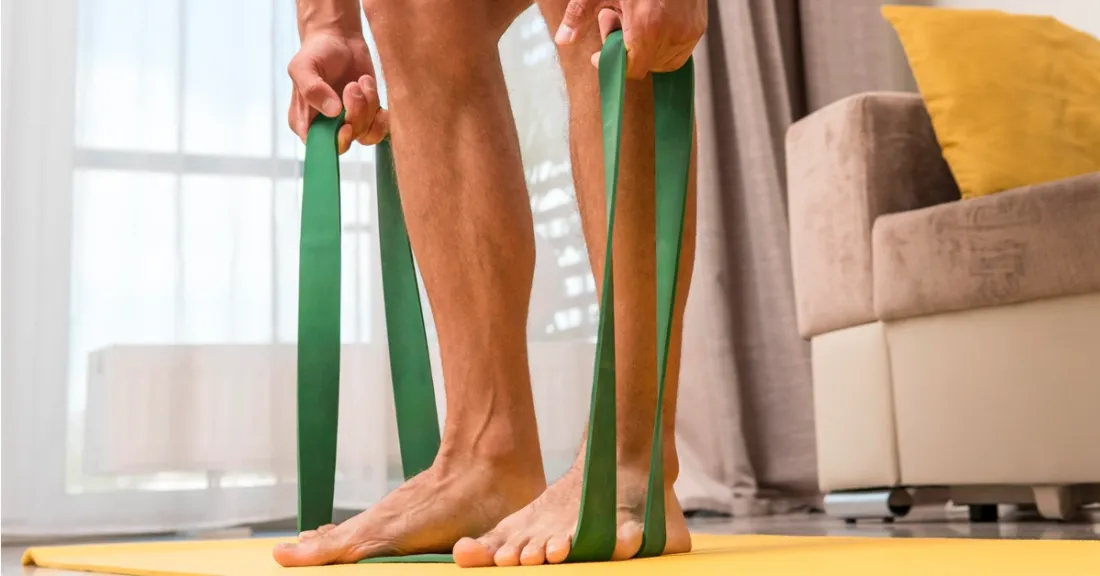
- Initiate resisted ankle plantarflexion exercises using resistance bands or tubing, avoiding dorsiflexion beyond neutral
- Introduce balance and proprioceptive training (e.g., balance board with dorsiflexion blocked)
- Continue modalities for swelling and pain control as needed
Boot Usage
- Gradual weaning off boot (usually by week 8)
- Use of Achilles-specific compression stocking recommended but not mandatory
Precautions
- Avoid dorsiflexion beyond neutral during strengthening and stretching
- Avoid activities that place sudden or excessive load on the tendon (e.g., lunges, squats)
- Monitor for signs of elongation (excessive dorsiflexion compared to contralateral side)
- Educate patient on gradual progression and adherence
Sample Exercises for Physiotherapists
- Active ankle plantarflexion strengthening with resistance bands
- Double heel raises progressing to single heel raises as tolerated
- Balance board exercises with dorsiflexion limitation
- Stationary cycling with low resistance
- Gait retraining focusing on proper heel-to-toe mechanics
- Closed kinetic chain exercises avoiding dorsiflexion past neutral
Stage 4: Advanced Strengthening and Functional Training (12–16 Weeks)
Goal
- Restore strength, power, and endurance of the calf musculature
- Normalize ankle range of motion
- Improve dynamic balance and proprioception
- Prepare for gradual return to functional activities and sports
Interventions
- Initiate calf stretching within safe dorsiflexion limits
- Progress strengthening exercises to weight-bearing closed and open kinetic chain movements
- Initiate low-impact aerobic exercises (e.g., elliptical, treadmill walking)
- Continue proprioceptive training and progress balance challenges
- Avoid high-load activities that cause excessive tendon stretch
Boot Usage
- No boot required
- Use of compression garments may continue for swelling control
Precautions
- Avoid aggressive dorsiflexion exercises
- Avoid high-impact activities, heavy resistance training, running, or jumping
- Monitor for any pain, swelling, or signs of tendon elongation or rerupture
Sample Exercises for Physiotherapists
- Gentle calf stretches
- Weighted heel raises (double and single leg)
- Step-ups and step-downs within pain-free range
- Balance and coordination drills on unstable surfaces
- Low-impact cardiovascular training (stationary bike, elliptical)
- Functional gait training and stair climbing
Stage 5: Return to Sport and Full Activity (16 Weeks to 12 Months)
Goal
- Return to pre-injury activity and sports participation safely
- Achieve at least 80% strength compared to contralateral side before light sports
- Achieve 100% strength before high-impact and cutting sports
- Prevent re-injury and tendon elongation
Interventions
- Gradual introduction of dynamic and sport-specific training (e.g., jogging, skipping, plyometrics)
- Focus on power, endurance, and agility training
- Progressive return to running, cutting, and jumping as tolerated
- Continue strengthening and proprioceptive exercises
Boot Usage
- No boot or heel wedges
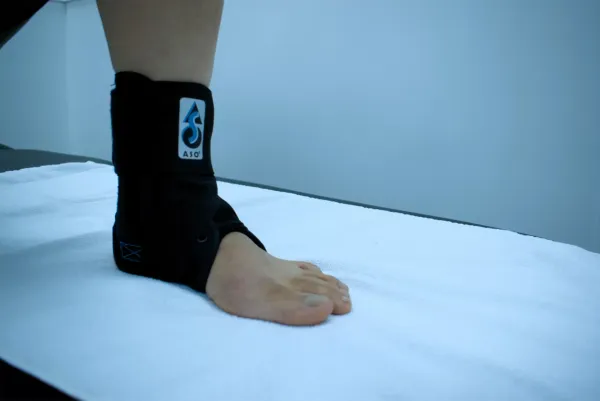
- Use of ankle brace or compression stocking optional for support during return to sport
Precautions
- Avoid contact sports and high-intensity activities until adequate strength and control are demonstrated
- Monitor for pain, swelling, or instability
- Emphasize patient education and compliance with gradual progression
Sample Exercises for Physiotherapists
- Progressive running drills starting with straight-line jogging
- Plyometric exercises (hops, bounds) with gradual intensity
- Agility drills (cutting, pivoting) after strength milestones are met
- Sport-specific drills under supervision
- Continued calf strengthening and balance work
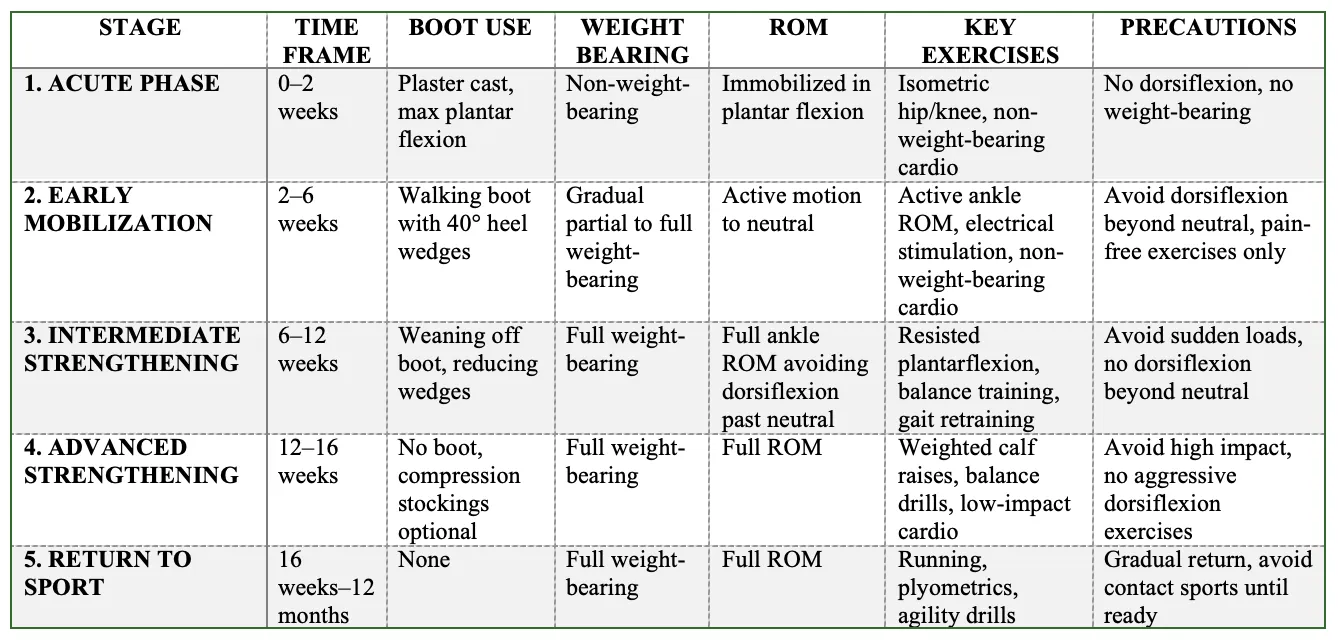
Summary Table of Rehabilitation Stages
Note: Risk of Elongation
Note: Importance of Patient Compliance and Supervision:
Frequently Asked Questions
Yes. In appropriate patients, an acute Achilles tendon rupture can be successfully managed without surgery using a structured functional rehabilitation program.
Non-operative treatment typically involves protecting the tendon in a specific position during the early stages, followed by progressive weight bearing, movement, strengthening, and functional rehabilitation.
Research has shown that appropriately selected patients undergoing non-operative treatment with functional rehabilitation can achieve outcomes comparable to surgical treatment, while avoiding complications associated with surgery.
Crutches are commonly required during the early stages of non-operative treatment to protect the healing tendon and help you walk safely.
The exact duration depends on the rehabilitation protocol prescribed by your orthopedic team. Some protocols begin with a period of non-weight bearing, followed by gradual weight bearing in a protective boot. Other functional protocols may allow earlier weight bearing in the boot.
Your physiotherapist will help you safely progress from crutches toward independent walking as your strength and control improve.
Weight bearing should follow your orthopedic team’s specific protocol.
Depending on the treatment approach, you may initially be non-weight bearing and then gradually increase weight bearing while wearing a walking boot with heel wedges. Some modern functional rehabilitation protocols allow earlier weight bearing in a protective boot.
Do not increase weight bearing or remove your protective boot or heel wedges without appropriate medical guidance.
The walking boot is used to protect the healing Achilles tendon while gradually allowing increased weight bearing and movement.
The duration varies between protocols. Heel wedges are typically removed gradually as healing progresses, allowing the ankle to move toward a more neutral position.
Your physiotherapist and orthopedic team will determine when it is appropriate to reduce the number of wedges and eventually transition out of the boot.
Walking normally takes time because the calf and Achilles tendon become significantly weaker following the injury and period of protection.
Early walking is performed with the protective boot and, when necessary, crutches. As the tendon heals and your strength improves, rehabilitation focuses on gradually restoring ankle movement, calf strength, balance, and walking mechanics.
You should progress toward normal walking without a significant limp before increasing the demands placed on the Achilles tendon.
You should return to driving only when you can safely control the vehicle and perform an emergency braking manoeuvre without significant pain or hesitation.
A walking boot, limited ankle movement, reduced strength, and delayed reaction time can all affect your ability to drive safely.
You should follow your healthcare provider’s recommendations and check with your insurance provider before returning to driving.
Your return-to-work timeline depends on the physical demands of your occupation and how your recovery is progressing.
A desk-based job may allow an earlier return, particularly if you can elevate your leg and take regular breaks. Jobs requiring prolonged standing, walking, climbing, lifting, or other physically demanding activities may require a longer recovery period.
A gradual return with temporary workplace modifications may be appropriate. Your physiotherapist can help assess your functional abilities and provide recommendations based on your specific job requirements.
Rehabilitation exercises begin progressively during the recovery process, but exercises must be appropriate for the stage of tendon healing.
Early rehabilitation focuses on protecting the tendon while maintaining strength and movement in areas that can be safely exercised. As healing progresses, the program can include ankle movement, resistance exercises, balance training, progressive calf strengthening, and cardiovascular exercise.
The amount and type of exercise should be increased gradually to avoid placing excessive stress on the healing tendon.
Stretching the Achilles tendon should not be rushed.
During the early stages of healing, excessive ankle dorsiflexion or forceful calf stretching can place unnecessary stress on the healing tendon and may contribute to tendon elongation.
Ankle movement is therefore introduced gradually according to your rehabilitation protocol. As healing progresses, your physiotherapist will determine when and how to safely introduce additional range-of-motion and calf flexibility exercises.
Running should not be started simply because a certain number of weeks or months have passed.
Before beginning a running program, you should demonstrate adequate ankle movement, calf strength, single-leg control, and tolerance to progressive loading activities without significant pain or swelling.
Your physiotherapist can assess your readiness and develop a gradual return-to-running program. Running is typically introduced only after sufficient tendon healing and substantial recovery of calf strength.
Returning to sport is a gradual process and requires considerably more than being able to walk comfortably.
Sports involving running, jumping, sprinting, cutting, or explosive movements place substantial demands on the Achilles tendon. Before returning to full sport, you should demonstrate appropriate calf strength, single-leg control, jumping and landing ability, running tolerance, and sport-specific performance.
Return to sport should be based on your functional recovery rather than a specific date on the calendar.
Calf strength can take a considerable amount of time to recover following an Achilles tendon rupture.
The injury itself, combined with the initial period of immobilization and reduced activity, can lead to significant weakness and loss of calf endurance.
Progressive strengthening is one of the most important components of rehabilitation. Your program will gradually progress from basic strengthening to single-leg calf exercises and eventually to more demanding activities such as jumping and running.
Strength may continue to improve for many months after the initial injury.
Recovery from an Achilles tendon rupture is a long-term process.
Basic daily activities and walking generally improve before higher-level strength and athletic function return. Recovery time varies depending on factors such as the severity and location of the rupture, age, activity level, treatment protocol, and response to rehabilitation.
Returning to running and sports can take many months, and some patients may continue to experience differences in calf strength or endurance even after returning to normal activities.
Rehabilitation should be progressed according to tendon healing, strength, movement, and functional performance rather than time alone.
The healing Achilles tendon is vulnerable during the early stages of recovery. Doing too much too soon can place excessive stress on the tendon and may increase the risk of tendon elongation or re-rupture.
Activities such as running, jumping, sudden acceleration, forceful stretching, and unprotected walking should not be introduced before the tendon is adequately prepared.
Following your rehabilitation protocol and progressing gradually are essential for allowing the tendon to heal while safely rebuilding strength and function. Patient compliance and close supervision are particularly important during non-operative rehabilitation.
References
- Coopmans, L., Amaya Aliaga, J., Metsemakers, W.-J., Sermon, A., Misselyn, D., Nijs, S., & Hoekstra, H. (2021). Accelerated rehabilitation in nonoperative management of acute Achilles tendon ruptures: A systematic review and meta-analysis. The Journal of Foot & Ankle Surgery. https://doi.org/10.1053/j.jfas.2021.07.007
- Frankewycz, B., Krutsch, W., Weber, J., Ernstberger, A., Nerlich, M., & Pfeifer, C. G. (2017). Rehabilitation of Achilles tendon ruptures: Is early functional rehabilitation daily routine? Archives of Orthopaedic and Trauma Surgery.https://doi.org/10.1007/s00402-017-2627-9
- Glazebrook, M., & Rubinger, D. (2019). Functional rehabilitation for nonsurgical treatment of acute Achilles tendon rupture. Foot and Ankle Clinics of North America, 24(3), 387-398. https://doi.org/10.1016/j.fcl.2019.05.001
- Korkmaz, M., Erkoc, M. F., Yolcu, S., Balbaloglu, O., Öztemur, Z., & Karaaslan, F. (2015). Weight bearing the same day versus non-weight bearing for 4 weeks in Achilles tendon rupture. Journal of Orthopaedic Science, 20(3), 513-516.
- Young, S. W., Patel, A., Zhu, M., Van Dijck, S., McNair, P., Bevan, W. P., & Tomlinson, M. (2014). Weight-bearing in the nonoperative treatment of acute Achilles tendon ruptures: A randomized controlled trial. Journal of Bone and Joint Surgery – American, 96(13), 1073-1079. https://doi.org/10.2106/JBJS.M.00248
- Zhang, H., Tang, H., He, Q., Wei, Q., Tong, D., Wang, C., Wu, D., Wang, G., Zhang, X., Ding, W., Li, D., Ding, C., Liu, K., & Ji, F. (2015). Surgical versus conservative intervention for acute Achilles tendon rupture: A meta-analysis. Medicine, 94(40), e1746. https://doi.org/10.1097/MD.0000000000001746